The Cadence Is the Signal
Something changed in the rhythm of AI announcements. The industry has moved from quarterly releases to what now resembles a continuous stream—174 tracked models from ten major labs since November 2022, with new frontier releases arriving roughly every 48 hours as of mid-2026.1 Each release follows a recognizable script: a launch post, a set of benchmark scores, a leaderboard position, and a comparison chart in which the announcing lab comes out ahead.
The pace itself has become a kind of marketing instrument. When releases come this fast, practitioners have little time to conduct independent evaluation before the next announcement overwrites the previous one. The implicit message—this model scores higher, therefore it performs better for your use case—rarely receives serious scrutiny before it becomes received wisdom.
What has emerged is something researchers and practitioners have started calling benchmark theater: evaluation performed as spectacle, with the substance stripped out.2 The benchmarks exist, and the scores are real. But the scores increasingly measure something other than what enterprise teams need to know—and a growing body of peer-reviewed research documents exactly how the gap between leaderboard performance and production behavior has opened up.
This is not a complaint about any single vendor. Every major lab participates in some version of this dynamic. The more important question is what enterprise directors, architects, and developers should actually be looking at instead—and what organizational capability they need to build to make model selection a durable, defensible decision rather than a quarterly exercise in reading press releases.
How Benchmarks Break
The mechanics of benchmark failure fall into three distinct categories, each with different implications for how much weight enterprise teams should place on published scores.
Saturation is the most widely acknowledged problem. When GPT-3 first attempted the MMLU benchmark—a 16,000-question test across 57 academic subjects—it scored approximately 35%. Today, every frontier model exceeds 88%, and a two-percentage-point difference between competitors falls within measurement noise.3 MMLU-Pro was designed to correct this, replacing four-choice questions with ten-choice graduate-level problems. As of early 2026, the leading model scores approximately 90% on MMLU-Pro—and that benchmark is itself approaching saturation, repeating the pattern it was built to solve.4 The Stanford 2026 AI Index captured the broader dynamic: frontier models gained 30 percentage points on Humanity’s Last Exam—a benchmark explicitly designed to resist AI capabilities—in a single year.5
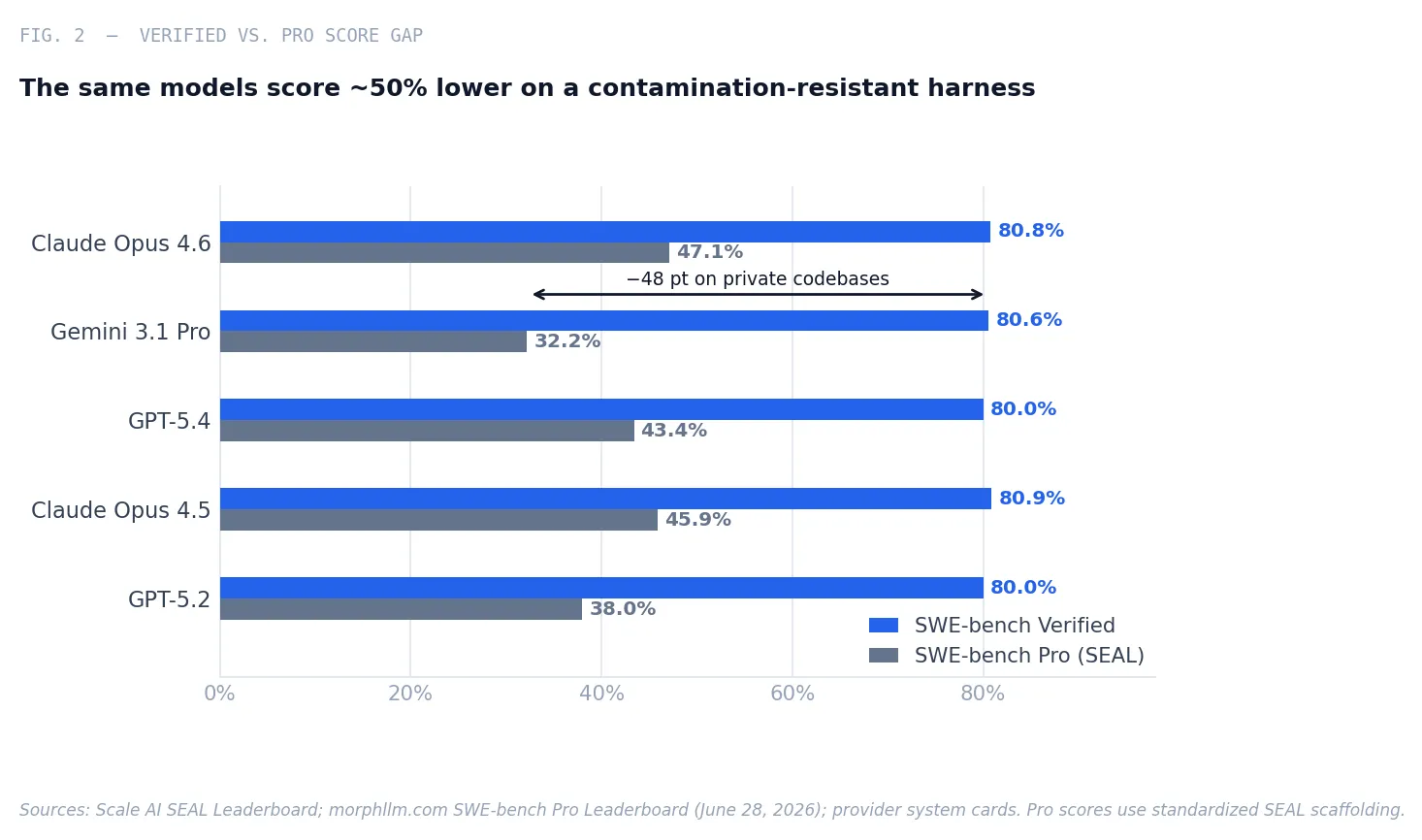
Contamination is the subtler problem. Most frontier models are trained on web-scale datasets that almost certainly include the very test sets those models are later evaluated on. Controlled experiments published in 2025 revealed that state-of-the-art models could correctly identify which file in a codebase needed to be modified to resolve a GitHub issue—even when given only the issue description and repository name, with no access to the code itself.6 OpenAI’s own internal audit found training data overlap with SWE-bench Verified tasks across every frontier model it tested, and subsequently stopped reporting Verified scores in favor of the contamination-resistant SWE-bench Pro.7 The same model that scores above 80% on Verified scores roughly 45–57% on Pro.8 Same model. Same code. Half the score.
Gaming is the most deliberately documented problem. In April 2025, a 68-page analysis by researchers from Cohere Labs, Princeton, Stanford, MIT, and the Allen Institute for AI—published at NeurIPS 2025—found systematic irregularities in how Chatbot Arena, the de facto standard for head-to-head model comparison, operates in practice.9 Analyzing approximately two million model comparison battles across 243 models, the paper found that major providers could test numerous private variants before any public release and selectively disclose only favorable scores. At the extreme, one provider tested 27 private variants before selecting the best-performing one for the public leaderboard.10
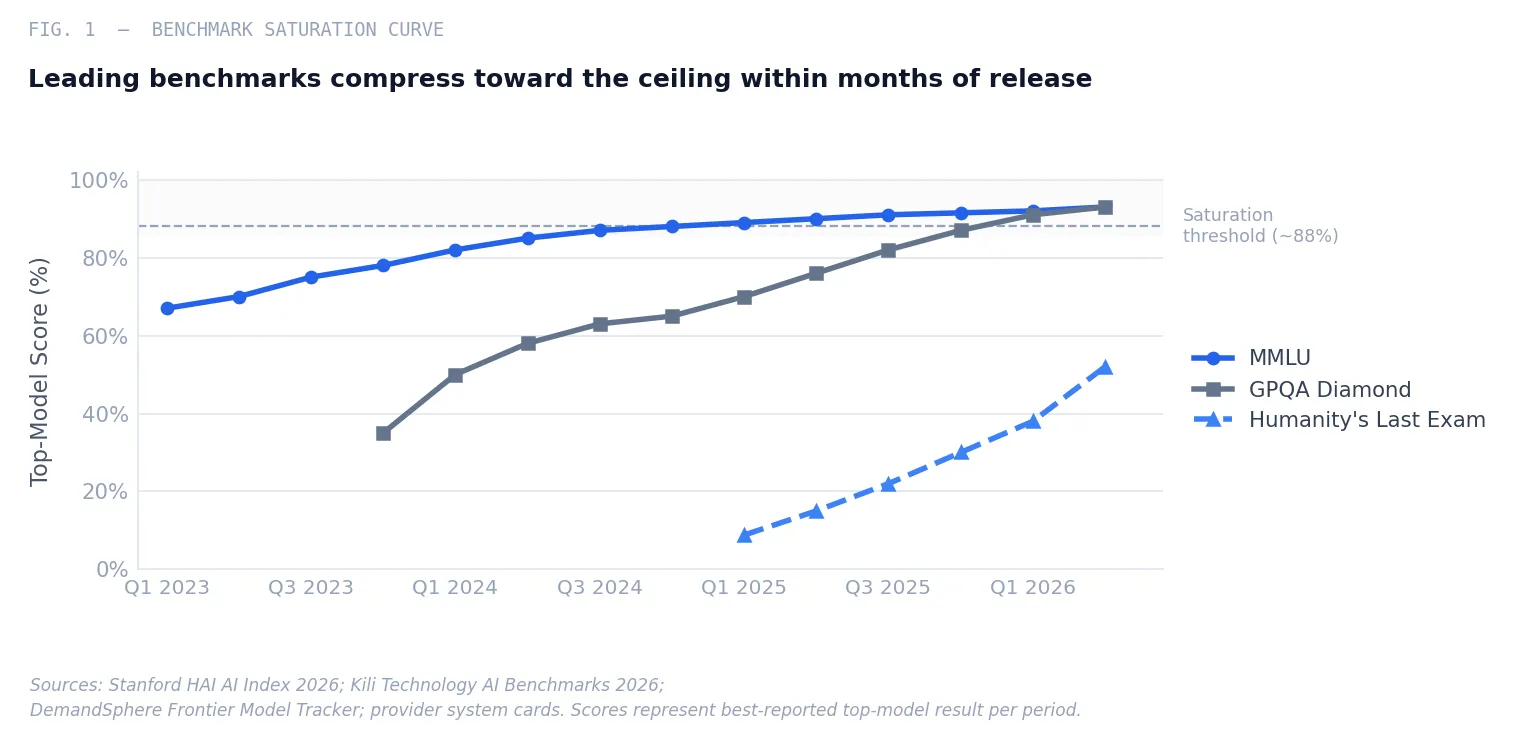
Taken together, these three failure modes create conditions where benchmark scores are simultaneously everywhere and nearly useless as procurement signals. Bessemer Venture Partners’ 2025 State of AI report was direct: “public benchmarks like MMLU, GSM8K, or HumanEval offer coarse-grained signals at best—and often fail to reflect the nuance of real-world workflows, compliance constraints, or decision-critical contexts.”11
Controlled Conditions Don’t Build Your Product
The failure modes above are structural—they exist regardless of which model is being evaluated. But there is a separate and more operationally significant problem: even well-constructed benchmarks test conditions that do not match enterprise deployment environments.
“AI models can win a gold medal at the International Mathematical Olympiad, but still can’t reliably tell time.”
— Stanford HAI, AI Index 2026
This is what Stanford HAI’s 2026 AI Index called the “jagged frontier”—the uneven, unpredictable boundary where AI capabilities abruptly succeed and then abruptly fail.12 Agents embedded in real enterprise workflows fail roughly one in three attempts on structured benchmarks, and documented AI production incidents rose to 362 in 2025, up from 233 the prior year.13 In controlled testing, research on enterprise agentic AI systems found a 37% gap between lab benchmark scores and real-world deployment performance—with consistent results dropping from 60% accuracy on a single run to 25% when measured across eight consecutive runs of the same task.14
Real deployment adds variables that controlled benchmark environments deliberately exclude. Network jitter, latency spikes, and node degradation introduce instability that lab testing cannot capture.15 Concurrency profiles change cost equations substantially—a model that performs well at light load may degrade significantly under the traffic patterns of a production system with many simultaneous users. Private codebases introduce context that training data has not seen. Most organizations discover this gap on the wrong side of procurement.
There is also the problem of advertised versus effective context windows. NVIDIA’s RULER benchmark found that models reliably use only 50–65% of their advertised context window before performance degrades.16 An enterprise deploying a model for long-document analysis or codebase-wide code review and relying on advertised context figures is making an architectural assumption that may not hold at scale. One analysis noted that a model advertising a ten-million-token context window may effectively function reliably at five to six million.17
None of this means benchmarks have no value. Benchmarks like GPQA Diamond, SWE-bench Pro, LiveCodeBench, and Humanity’s Last Exam are meaningfully harder to saturate and contaminate than their predecessors. They function as a reasonable shortlist filter—a way to identify which models are worth evaluating, not a way to determine which model is right for a specific production use case. A benchmark score is to model selection what a resume is to hiring: necessary but not sufficient, and specifically inadequate for predicting performance in the actual job.
Task, Architecture, Cost, Compliance: The Four Dimensions Benchmarks Don’t Map
The procurement frame has shifted. The question is no longer which model scores highest on a leaderboard. It is which model performs best on a specific task, at a specific cost point, with a specific latency budget, inside a specific compliance envelope.
Enterprise teams selecting AI models in 2026 are navigating a decision space that benchmarks were not designed to map. Four dimensions consistently determine actual deployment outcomes—and benchmark scores are a weak proxy for all of them.
Task-specific fit diverges from general benchmark performance in ways that matter. SWE-bench Pro’s private commercial set—276 tasks drawn from real startup codebases not available on the public internet—produced a different ranking than the public leaderboard.18 One leading model held the top position on both; another dropped 13.9 percentage points moving from public to private code. The divergence is exactly what practitioners encounter: the model evaluated on published benchmarks is not necessarily the model that performs on your private codebase. Architects in fine-tuned vertical deployments are finding that 7B–13B parameter models can outperform frontier generalists on narrow tasks at 10–15% of the inference cost—a structural reality that general-capability benchmarks never surface.19
Architecture carries procurement consequences that benchmark summaries rarely address. Mixture-of-Experts (MoE) designs now underlie more than 60% of open-source frontier model releases.20 MoE achieves competitive benchmark performance by activating only a subset of its parameters per token—efficient at low concurrency. But all expert parameters must reside in GPU memory even when inactive,21 and as concurrent requests increase, more distinct experts activate, eroding the efficiency advantage rapidly.22 A benchmark evaluating a single response under controlled conditions will not surface this. A production system serving thousands of simultaneous developers will.
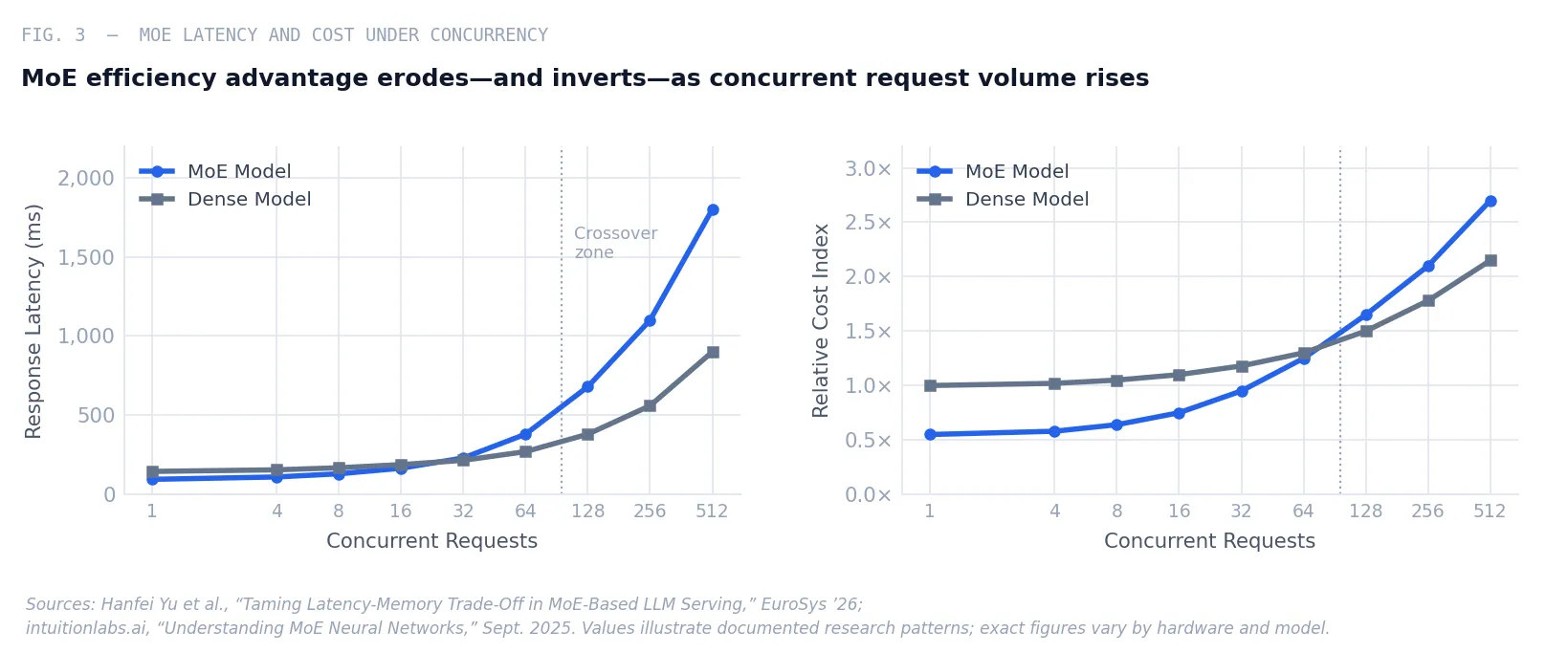
Cost at operational volume is almost never what benchmark documentation implies. API pricing fell roughly 80% from 2025 to 2026, but consumption rose faster than prices dropped.23 Effective cost at enterprise scale depends on the input-to-output token ratio of your actual workflows, your concurrency profile, prompt caching applicability, and whether volume justifies self-hosting. A comparison of published per-token rates is to total cost of ownership what a sticker price is to the ten-year cost of a commercial vehicle.
Compliance frequently determines eligibility before capability is relevant. The EU AI Act’s high-risk provisions took full effect in August 2026. HIPAA has never formally adapted to LLMs. A 2025 court order in New York Times v. OpenAI requiring indefinite retention of certain chat data made enterprise legal teams substantially more cautious about what flows through third-party APIs.24 For regulated industries, the compliance envelope narrows the candidate set before any benchmark score enters the conversation.
How Labs Game the System—and What They Ship Instead
Vendors understand the benchmark system better than any enterprise procurement team, and their behavior reflects it.
The Leaderboard Illusion paper documented that major providers were able to test multiple private variants before public release and selectively disclose only the best-performing scores—with the combined battle share of OpenAI, Google, Meta, and Anthropic on Chatbot Arena representing 68 times the share of top academic and non-profit labs.25 This is not a conspiracy; it is the predictable result of a system in which leaderboard position influences purchasing decisions and large providers have the engineering resources to optimize specifically for evaluation conditions. Goodhart’s Law—when a measure becomes a target, it ceases to be a good measure—has rarely found a more hospitable environment.
What vendors are acting on internally often looks different from what the leaderboard implies externally. Several labs now release model families rather than single models, with routing logic built into the API layer—meaning the model a developer thinks they are calling may itself be a composite that selects among internal specialists based on the query type. The benchmark score applies to that composite in controlled conditions. The routing behavior in production may differ. MoE architectures represent this logic implemented at the weight level rather than the API layer, but the structural dynamic is similar: what scores on the benchmark and what runs in production are not necessarily the same thing evaluated under the same conditions.
The evaluation arms race is itself accelerating. LiveCodeBench refreshes test questions monthly from recent competitive programming contests specifically to prevent contamination. Humanity’s Last Exam uses questions at the boundary of what experts know to resist saturation. FrontierMath requires original mathematical reasoning rather than pattern recognition. These are improvements—but they test narrow capability bands. The enterprise use case is rarely competitive mathematics or research-level science. It is code review across a mixed-language private codebase, or document extraction from proprietary contracts, or classification of customer support tickets at scale.
Five Principles for Model Selection That Holds Under Scrutiny
The organizations getting this right have stopped treating model selection as a one-time procurement decision and started treating it as an ongoing evaluation function. Several principles characterize how they operate.
Build task-specific evaluation suites before procurement. The highest-ranked model on a leaderboard might fail your specific workflow. A cheaper model might handle it cleanly with the right schema and validation.26 The only way to know is to test on your actual data, your actual task distribution, and your actual quality criteria—not on a publicly available benchmark designed for a different purpose. This is not exotic; it is what mature software procurement has always looked like. The novelty is that AI teams have been trained by the industry to defer to external leaderboards instead.
A practical starting point: instrument your existing workflows to capture real examples of the tasks you need AI to perform, including examples that currently fail or require human correction. That corpus becomes the basis of an internal evaluation suite. Run candidate models against it before any procurement decision. The Bessemer State of AI report described the industry directional shift: “instead of chasing leaderboard scores, companies are building internal eval suites to measure how AI performs across privacy-sensitive workflows, customer support, document parsing, and agent decision-making.”27
Evaluate models against your concurrency and latency profile, not benchmark conditions. Run candidate models under your actual or projected load patterns before signing a committed spend agreement. For MoE architectures specifically, test at the concurrency levels your production system will see—not at the single-request latency the vendor publishes. If your system requires sub-800ms response times at high concurrency, confirm that the model delivers under those conditions, not just in isolation.
Separate the shortlist function from the selection function. Public benchmarks are reasonable for narrowing the field. GPQA Diamond, SWE-bench Pro, and LiveCodeBench provide meaningful signal for identifying models worth evaluating. They are poor tools for final selection. Use them to produce a candidate set of three to five models, then evaluate that candidate set against your internal task suite.
Architect for model agnosticism from the start. IDC’s 2026 AI FutureScape projects that by 2028, 70% of top AI-driven enterprises will use multi-tool architectures to dynamically manage model routing across diverse models.28 In 2026, 37% of enterprises already run five or more models in production simultaneously.29 The practical implication: the model you select today will likely coexist with models you have not yet evaluated. Building model-agnostic scaffolding—a routing layer that separates application logic from specific model APIs—means a better model released next quarter is a configuration change rather than a migration project. Optimizing any part of your system around whichever model happens to top the leaderboard this week means rebuilding every few weeks.
Treat benchmark scores as vendor claims, not objective measurements. Require vendors to provide performance data on tasks representative of your use case. Ask specifically which benchmarks were used to validate the scores they publish—and whether those benchmarks were administered by the vendor or by an independent third party. The growing emergence of private leaderboards run by Scale AI’s SEAL program and others represents a meaningful improvement in evaluation integrity, because the test harness is standardized and controlled. Vendor-reported scores using proprietary scaffolding cannot be directly compared to scores from standardized harnesses—and the gap can be substantial.
Reading the Room Before Reading the Score
The benchmark system is not going away, and it should not. Standardized evaluation is essential to scientific progress, and the evaluation science community is making genuine improvements—contamination-resistant benchmarks, independent harnesses, multi-dimensional scoring frameworks that incorporate cost, latency, and reliability alongside accuracy. The direction of travel is toward more rigorous and more trustworthy public evaluation, not away from evaluation entirely.
But the pace of model releases has outrun the pace of evaluation reform. In the interval between now and when the evaluation infrastructure catches up, enterprise teams that treat leaderboard position as a procurement signal are making decisions on information that may tell them a great deal about how a model performs in controlled academic conditions and relatively little about how it will perform on their data, under their load, with their compliance constraints.
The framework is not complicated: use public benchmarks to identify candidates, build internal evaluations to select among them, architect for the model to be replaceable, and run continuous evaluation in production. What makes it hard is organizational, not technical—it requires treating model selection as an engineering discipline rather than a marketing event.
Every two days, a new model arrives with a new score. The score is not the answer to the question enterprise teams need to ask. Knowing the difference is the capability that separates organizations that extract durable value from AI from those that perpetually re-evaluate the latest release without ever deploying anything at scale.
References
- AI Flash Report, “AI Model Release Timeline 2025–2026 — Every LLM Launch Tracked,” aiflashreport.com, updated June 22, 2026.
- AI Accelerator Institute, “The Benchmark Gap Explained: What AI Leaderboards Measure and What They Miss,” aiacceleratorinstitute.com, June 2026.
- Kili Technology, “AI Benchmarks 2026: Top Evaluations and Their Limits,” kili-technology.com, April 13, 2026.
- Kili Technology, “AI Benchmarks 2026: Top Evaluations and Their Limits,” kili-technology.com, April 13, 2026.
- Raymond Perrault et al., “The 2026 AI Index Report: Technical Performance,” Stanford HAI, April 2026.
- Shanchao Liang, Spandan Garg, and Roshanak Zilouchian Moghaddam, “The SWE-Bench Illusion: When State-of-the-Art LLMs Remember Instead of Reason,” arXiv:2506.12286, published June 2025, revised December 2025.
- CodeAnt AI, “SWE-bench Leaderboard 2026: All Model Scores, Rankings, and What They Actually Mean,” codeant.ai, May 2026.
- ACR, “SWE-bench Scores and Leaderboard Explained (2026),” aicodereview.cc, March 2026.
- Shivalika Singh et al. (Cohere Labs, Princeton, Stanford, MIT, AI2, University of Waterloo, University of Washington), “The Leaderboard Illusion,” NeurIPS 2025 Datasets and Benchmarks Track, arXiv:2504.20879, published April 2025, revised April 2026.
- Singh et al., “The Leaderboard Illusion,” arXiv:2504.20879.
- Bessemer Venture Partners, “The State of AI 2025,” bvp.com, August 15, 2025.
- Perrault et al., “The 2026 AI Index Report: Technical Performance,” Stanford HAI, April 2026.
- VentureBeat, “Frontier Models Are Failing One in Three Production Attempts—and Getting Harder to Audit,” venturebeat.com, April 15, 2026.
- Kili Technology, “AI Benchmarks 2026: Top Evaluations and Their Limits,” kili-technology.com, April 13, 2026. See also: research on the CLEAR framework, cited therein.
- VentureBeat, “What AI Benchmarks Miss About Real-World Performance,” venturebeat.com, June 2026.
- iternal.ai, “LLM Comparison 2026: 30+ Models Benchmarked and Ranked,” iternal.ai, May 30, 2026. (Citing NVIDIA RULER benchmark methodology.)
- iternal.ai, “LLM Comparison 2026,” iternal.ai, May 30, 2026.
- morphllm.com, “SWE-bench Pro Leaderboard (2026),” morphllm.com, updated June 28, 2026.
- cloudhew.com, “Enterprise AI Strategy 2026: Agentic Workflows and Multi-Model,” cloudhew.com, May 14, 2026.
- NVIDIA, “Mixture of Experts Powers the Most Intelligent Frontier AI Models,” blogs.nvidia.com, March 3, 2026.
- intuitionlabs.ai, “Understanding Mixture of Experts (MoE) Neural Networks,” intuitionlabs.ai, September 26, 2025.
- Hanfei Yu et al., “Taming Latency-Memory Trade-Off in MoE-Based LLM Serving via Fine-Grained Expert Offloading,” EuroSys ‘26, April 2026.
- iternal.ai, “LLM Comparison 2026,” iternal.ai, May 30, 2026.
- Towards Data Science, “How to Choose Between Small and Frontier Models,” towardsdatascience.com, June 2026.
- Singh et al., “The Leaderboard Illusion,” arXiv:2504.20879.
- Logic Inc., “AI Model Benchmarks 2026: GPT, Claude, Gemini Compared,” logic.inc, May 20, 2026.
- Bessemer Venture Partners, “The State of AI 2025,” bvp.com, August 15, 2025.
- IDC, “The Future of AI Is Model Routing,” idc.com, December 11, 2025. (Citing IDC 2026 AI and Automation FutureScape.)
- Swfte AI, “Intelligent LLM Routing: How Multi-Model AI Cuts Costs by 85%,” swfte.com, June 2, 2026.