Nearly Half Over Plan, and Few Slowing Down
On September 10, The Futurum Group published the results of its second-half 2026 survey of 1,636 enterprise technology decision-makers. The headline number was that 46.9% of organizations report actual AI spend exceeding their planned AI budget, while only 5.6% came in under plan.1 Overruns in a fast-growing category are not unusual, so the more revealing data sat one layer down, in what organizations did once they noticed.
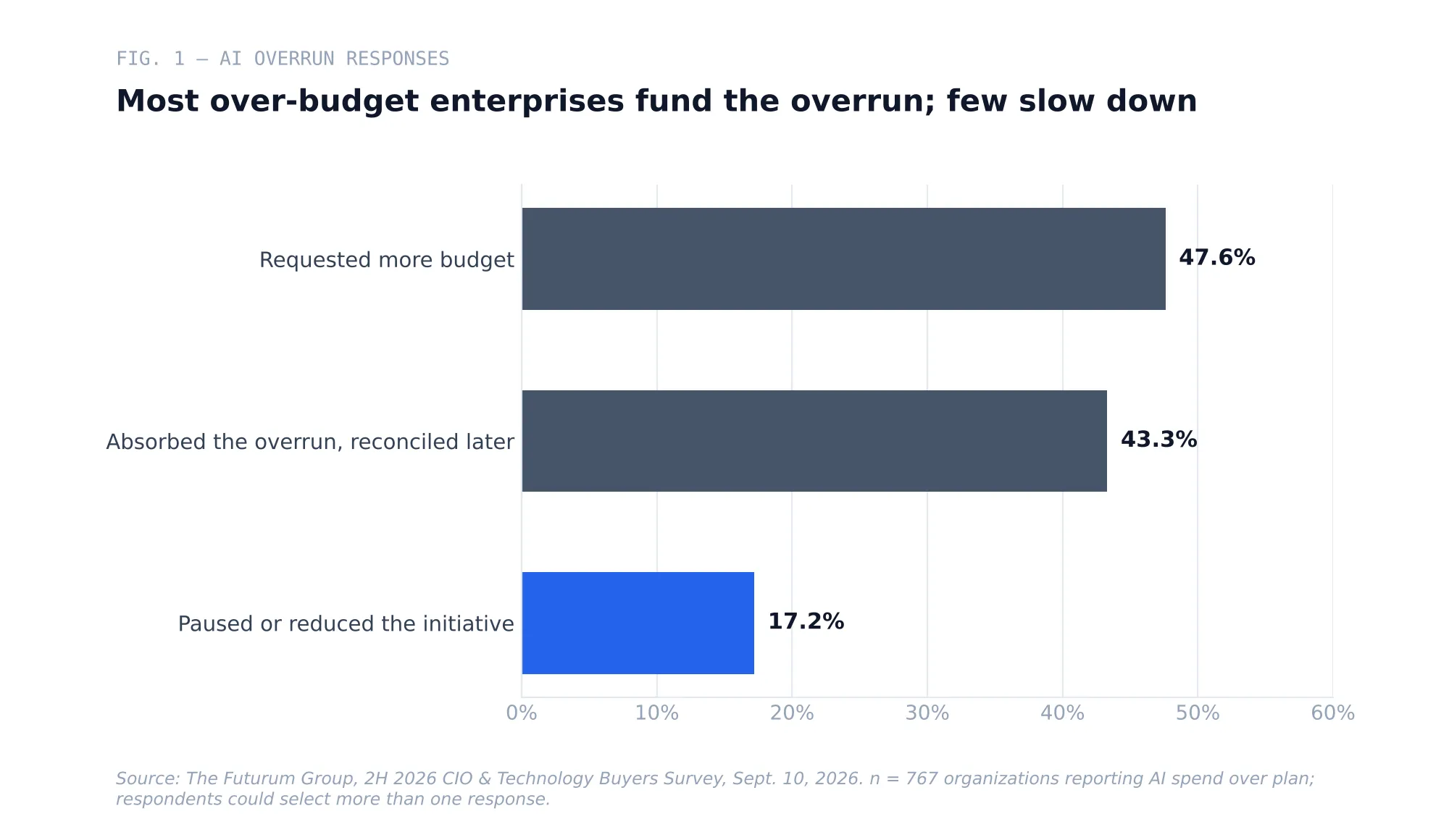
Among the 767 organizations running over plan, 47.6% requested more budget and 43.3% absorbed the overrun to reconcile later. Only 17.2% paused or reduced the initiative itself.1 When the gap was funded by reallocating within IT, external contractors and consultants were the first line cut, at 60.9% of reallocating organizations.1 Mitch Ashley, who leads Futurum’s CIO practice, summarized the pattern in a single line.
“…the budget has stopped being a control.”
— Mitch Ashley, VP and Practice Lead, CIO and Technology Buyers, The Futurum Group, September 10, 2026
The survey does not ask why spend is running hot, and it would overreach to claim it proves any single cause. When the figures are set beside the rest of the 2026 adoption data, however, they describe a familiar reflex in which disappointing results get blamed on the tool and the remedy becomes another tool. Consequently, the license count rises and the meter runs faster while the people operating those tools keep exactly the habits they had before the purchase.
It does not matter which brand of car a company buys for someone who never learned to drive, and buying that person a second car does not help either. The underlying problem is that fact that many AI users are simply untrained on how to use the tools effectively.
A Capability Gap Recorded as a Budget Line
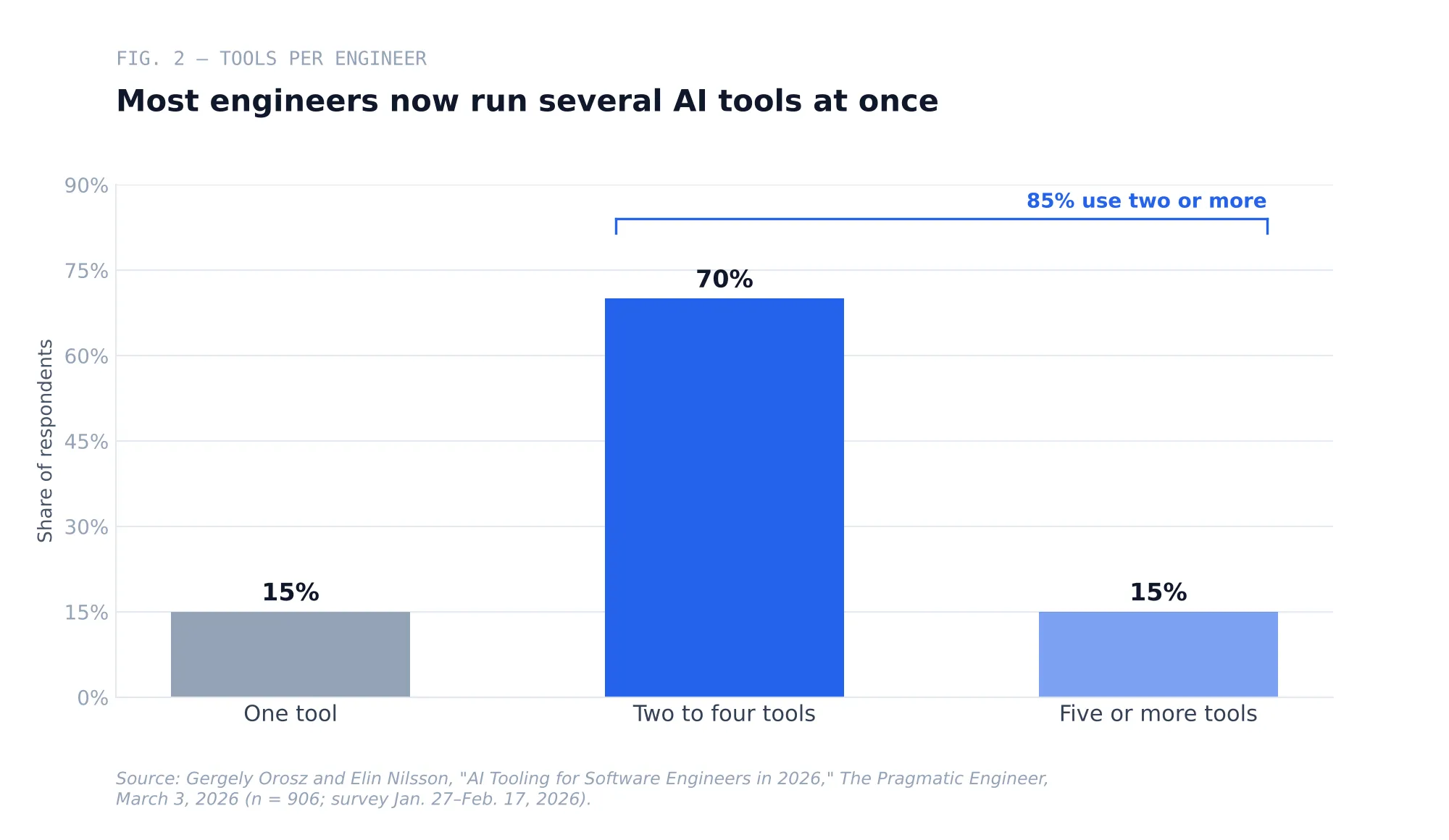
Tool expansion has moved well beyond the edge case. In The Pragmatic Engineer’s 2026 survey of 906 software professionals, 70% reported using between two and four AI tools at once, and another 15% reported using five or more; only 15% worked with a single tool.2 The pattern shows up in spend data as well. Zylo’s 2026 SaaS Management Index, built on more than 40 million licenses, found spending on AI-native applications up 108% year over year across its customer base and up 393% in organizations with more than 10,000 employees.3
Although some of that growth reflects genuine new use cases, the waste indicators are rising alongside the spend. In Flexera’s 2026 State of ITAM Report, 59% of respondents said wasted AI spend had increased over the prior year, and only 31% reported accurate visibility into their AI software at all.4 Enterprises are adding AI tools faster than they can see them, which makes it difficult to tell whether a disappointing result came from the tool or from the person using it.
The distinction matters because the two diagnoses lead to opposite purchases. After all, if the tool is the constraint, a different or additional tool is the rational response. If the operator is the constraint, every additional tool inherits the same constraint and adds a new cost structure on top of it.
The most direct evidence comes from platform usage data collected at scale. Anthropic’s March 2026 Economic Index report compared users who had been on its platform for six months or longer with newer users. Across a sample of one million conversations, longer-tenured users were more likely to iterate with the model than to simply delegate, more likely to use it for work, and more likely to succeed. After controlling for the specific task, model, use case, language, and country, the high-tenure group still showed roughly a four-percentage-point higher success rate.5 The authors are careful to note that cohort effects and survivorship bias could account for part of the gap, since early adopters tend to be more technical and users who stopped seeing value are no longer in the sample.5 Even with those caveats, the within-task comparison is the closest thing the industry has to a controlled measure, and it says the same model on the same task performs differently depending on who is asking.
Nevertheless, it is vendor data about the vendor’s own product, which is a reason to test it against independent evidence before leaning on it. Boston Consulting Group’s 2026 AI at Work survey, covering 11,749 employees, managers, and leaders across 14 markets, offers that test from a different angle.6 BCG compared respondents by two variables, the clarity of their organization’s AI strategy and the strength of their access to AI tools. Among respondents with limited strategy and limited tools, 55% reported measurable impact, a figure that strong tool access alone raised to 60%. Strong strategy with limited tools raised it to 80%, and both together reached 83%.6
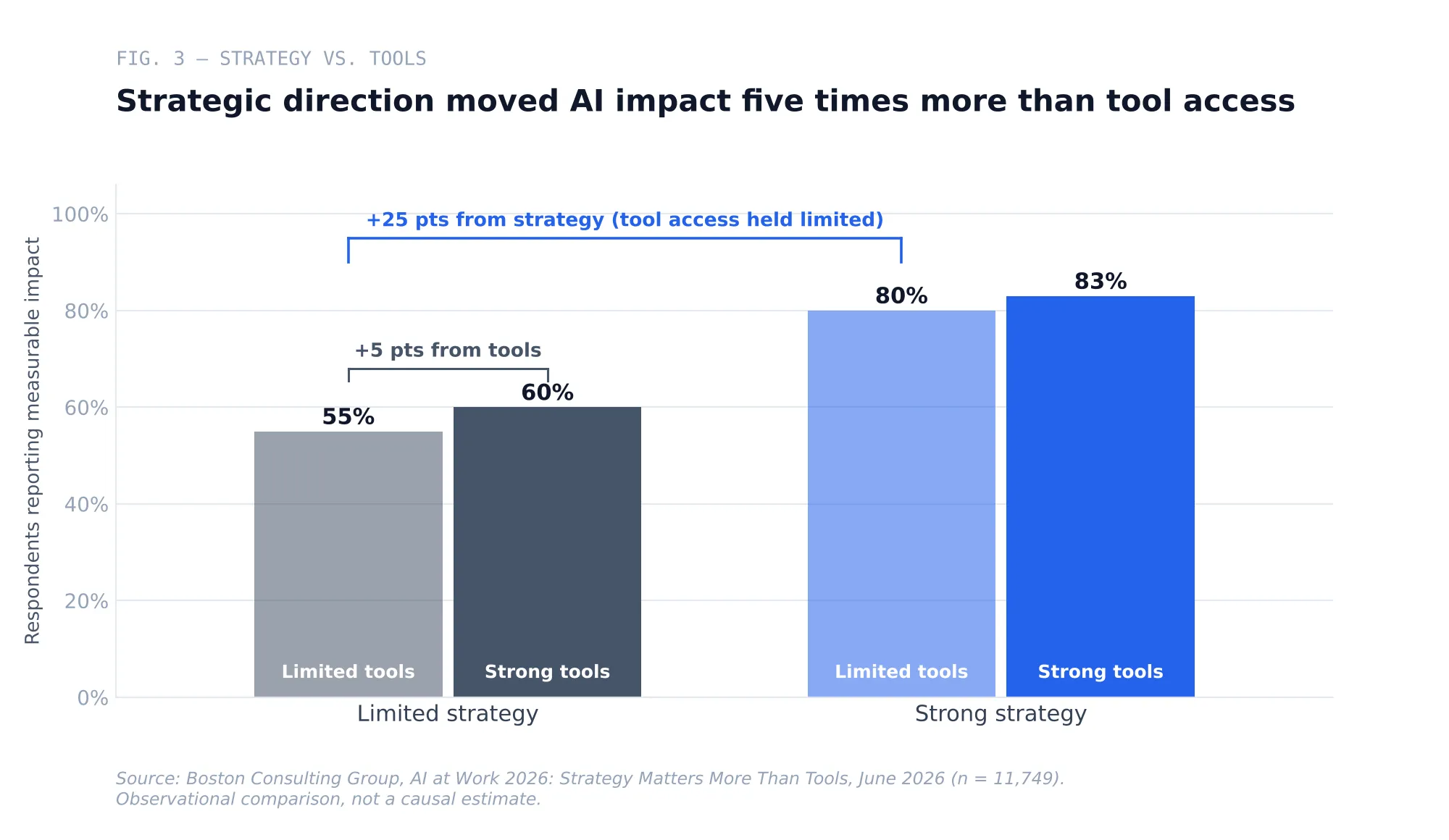
This comparison is observational, and “strategy” in BCG’s framing includes guidance, training, and leadership direction rather than skill alone. However, the asymmetry is difficult to dismiss. Moving from limited to strong tool access was worth five points. Moving from limited to strong strategic direction, with the tools held constant, was worth twenty-five. The same survey found that 72% of workers say the skills expected in their roles have already shifted because of AI, while only 36% believe they have received adequate upskilling.6
How Tool Expansion Multiplies the Gap
If operator capability is the binding constraint, the economics of adding tools shift in three specific ways that compound one another.
The meter multiplies. Pricing across the coding-assistant market has moved decisively toward consumption. GitHub moved every Copilot plan to usage-based billing on June 1, 2026, with each plan carrying a monthly allotment of AI Credits and additional usage billed against a spending budget.7 Furthermore, competing agentic tools bill on tokens directly or through credit systems that track them. Gartner warned in June that organizations moving from experimentation to scaled deployment of coding agents are underestimating the financial impact of token consumption, and projected that AI coding costs will overtake the average developer’s salary by 2028.8 Whereas an unskilled user under seat pricing wasted a fixed license, the same user under consumption pricing wastes a variable amount that scales with how inefficiently they work. A developer who re-prompts five times instead of once, loads an entire repository into context to ask a narrow question, or abandons sessions halfway through pays that overhead in every tool they are given, so a second tool simply starts a second meter running on the same habits.
The learning curve resets. Anthropic’s tenure data suggests that effectiveness accumulates with practice on a platform.5 Every coding tool now expects its own context conventions, whether a repository instruction file, a rules directory, an AGENTS.md, or a vendor-specific equivalent, and each one behaves differently around model selection, agent autonomy, and context limits. Interestingly, the Pragmatic Engineer survey surfaced a telling detail on this point, with roughly one in eight respondents saying they simply use whatever model their company sets as the default.2 Choosing the right model for the task is itself a skill, and Anthropic’s data shows users reserving its most capable and most expensive model class for higher-value work, with programmatic API users matching model to task about twice as strongly as chat users.5 Where the organization has not taught that judgment, each added tool brings one more default setting that nobody actually chose.
The governance surface expands. Each tool brings its own administrative console, data-handling terms, audit trail, and spending controls. Additionally, Flexera’s finding that fewer than a third of organizations have accurate visibility into AI software is a symptom of exactly this.4 A CIO who cannot see consumption across tools cannot attribute it to outcomes, and therefore cannot distinguish productive heavy users from inefficient ones. Uber illustrates where that leads, since after encouraging aggressive adoption of agentic coding tools, the company reported exhausting its full 2026 AI coding-tools budget within roughly four months and subsequently capped spending at $1,500 per employee per month for each tool.9 The cap applies per tool, which means the governance answer itself scales with the number of tools in the estate.
The strongest objection to this argument deserves a fair hearing. It holds that prompting skill is a fading concern, since frontier models now infer intent well enough that elaborate prompt craft has lost most of its value, and practitioners have largely moved to talking about context engineering instead. Admittedly, the phrasing tricks of 2023 do matter less in 2026. However, the shift moves the skill into a different set of decisions. Deciding what a model should see, how much autonomy to grant an agent, when to stop and review, and how to evaluate output that sounds confident are all learned capabilities, and they matter more as tools become more autonomous and more expensive per action. A second objection holds that different tools suit different workflows, and a terminal-based agent and an IDE assistant can certainly coexist in a well-run organization. The test is whether the second tool serves a workflow the first one handles poorly, or whether it covers for a capability the organization never built.
What the CIO Is Actually Buying
For a CIO, the practical consequence is that a request for an additional AI tool should be treated as a diagnostic event before it is treated as a procurement event. The request usually arrives as a capability claim about another product, and sometimes the claim is correct. Frequently, though, it is the visible symptom of something the organization has not measured, namely whether the people using the current tool are using it well.
However, the CIO-level evidence suggests most organizations are not positioned to answer that question. In Logicalis’s 2026 CIO Report, almost nine in ten organizations said a lack of internal technical capability was holding back their AI ambitions, and 62% of CIOs said they had compromised on governance because of limited knowledge.10 Dataiku’s September 2026 survey of 685 CIOs found that 47% had already decommissioned more than 20 AI agents this year.11 Although a healthy portfolio should retire what does not work, at that volume it is fair to ask how many of those agents were built or deployed by teams that had not yet learned what a well-scoped agent looks like.
The Futurum data adds a further wrinkle, since over-budget organizations that reallocate within IT cut external contractors and consultants first.1 In many enterprises those contractors are precisely the people carrying implementation knowledge for the platforms in question. Therefore, cutting them to fund more licenses trades the knowledge for the seat count, which runs directly against what the capability evidence recommends.
This has a direct financial framing, which is where the CFO and CIO conversation should start. Tool spend is easy to see and easy to approve because it appears as a discrete line with a vendor, a contract, and a renewal date. Capability spend is diffuse, slower to show results, and frequently sits in an HR or learning budget the CIO does not control. Consequently, the organization optimizes the visible line and starves the invisible one, and then reads the resulting underperformance as a tool problem. As I argued in Economics of Agent Value, the meaningful unit of AI cost puts accepted output in the denominator rather than tokens or seats, and operator skill moves that denominator more than any license choice does.
Every Vendor Is Now Selling Literacy
The vendors have reached a version of this conclusion themselves, and their behavior over the past year carries as much signal as it does marketing. OpenAI went furthest in its framing, presenting its partner program as a response to implementation challenges rather than model limitations.12 Every major provider has launched or expanded a skills program over the past fifteen months, and each one, unsurprisingly, centers its own products:
| Provider | Enablement move | Scope | Primary orientation |
|---|---|---|---|
| Microsoft / GitHub | Microsoft Elevate, July 2025: $4 billion in cash and technology over five years13 | Goal of 20 million people earning an AI credential | Education and nonprofit sector; Microsoft and GitHub tooling |
| OpenAI | OpenAI Partner Network, June 2026: $150 million investment12 | Goal of 300,000 certified consultants by end of 2026 | Partner-led enterprise deployment of OpenAI products |
| Google AI Professional Certificate, February 202614 | Seven-course workplace AI program on Coursera | Applied fluency using Gemini and Workspace | |
| Anthropic | Anthropic Academy, March 202615 | Free self-paced courses, including a technical architect credential | AI fluency and Claude developer platform |
The pattern supports a generous reading and a skeptical one, and both are probably true at once. The generous reading is that the providers see the same capability data the surveys show and recognize that their revenue depends on customers succeeding. The skeptical reading is that consumption pricing aligns vendor revenue with usage volume regardless of usage quality, and that vendor-run enablement naturally deepens attachment to a single platform. Either way, the implication for buyers stays the same. When every vendor is simultaneously investing in teaching customers to use AI, the market is acknowledging that the product alone does not deliver the outcome. A vendor curriculum is also, by design, a curriculum in that vendor’s tool, and an enterprise that relies on four vendors for its training will end up with four partial curricula and no shared standard.
Building the Driver Before Buying the Car
The response that follows from the evidence leaves room for every tool and every vendor in the market, since what it changes is the order in which an enterprise spends. Instead of rationing tools, the discipline sequences them behind capability, and it can be adopted within a single budget cycle:
-
Gate every new AI tool request on a capability diagnosis. Before approving a second or third tool for a team, establish how the team uses the current one. Measure acceptance rates, session abandonment, re-prompt frequency, context size, and consumption per accepted change. If those numbers show inefficient use, the tool is not the constraint, and the money belongs in enablement. If they show skilled, saturated use, the case for an additional tool becomes far stronger, and the new tool should arrive with a distinct, documented workflow so that overlap can be retired at renewal. A second tool with a named job is a portfolio decision, whereas one adopted because the first seemed disappointing is usually a training decision that nobody made.
-
Fund enablement as a line item inside the AI budget. BCG’s January 2026 AI Radar survey of 2,360 executives found that companies led by its most aggressive “Trailblazer” CEOs allocated 60% of their AI budgets to upskilling and retraining, compared with 27% and 24% for the two more cautious groups.16 Whatever ratio an enterprise chooses, capability spend should sit in the same budget, under the same owner, and against the same outcome metrics as tool spend. Otherwise the two lines will continue to be optimized separately by different owners.
-
Build a vendor-neutral core curriculum, then layer vendor training on top. The durable skills, including context selection, task decomposition, delegation boundaries, output verification, and cost awareness, transfer across every tool. Teach those once, as an internal standard, and use vendor academies for product-specific mechanics. Furthermore, a shared core curriculum lowers switching costs whenever the portfolio changes.
-
Instrument consumption per person and coach the heaviest spenders. Spending caps are a necessary backstop, and Uber’s per-tool limit is a reasonable control.9 However, a cap only limits the damage of inefficient use. Consumption telemetry, paired with coaching from the organization’s most effective users, addresses the inefficiency itself. The highest-tenure, highest-success users identified in Anthropic’s data exist inside every enterprise and are the cheapest trainers available.5
-
Protect implementation knowledge when budgets tighten. The Futurum data shows contractors being cut first to cover AI overruns.1 Therefore, before releasing anyone who carries platform knowledge, make sure that knowledge has been transferred to permanent staff, documented, or encoded in shared context files that every tool can read.
The Principle Every additional AI tool is a multiplier on whatever capability already exists. Applied to skilled operators, it multiplies leverage, and applied to unskilled ones, it multiplies cost, governance surface, and the number of places the same gap can hide.
The Keys Were Never the Hard Part
The 2026 data describes an industry that has largely solved access. Indeed, engineers have the tools, often several of them, and budgets have grown to fund them, frequently past plan. What has not kept pace is the capability to use those tools well, and the most common enterprise response to that gap has been to purchase around it. That response is understandable, since a license is quick to buy and easy to measure, while competence is slow to build and harder to see. However, the evidence from usage logs, workforce surveys, and CIO budgets points in the same direction. Capability compounds with practice, whereas a license delivers the same thing on its last day as on its first, and until enterprises fund the driver with the same seriousness as the fleet, each new car in the garage will add to the bill without shortening the trip.
References
- The Futurum Group, “46.9% of Enterprises Report AI Spend Over Budget in 2H 2026,” press release, September 10, 2026, https://futurumgroup.com/press-release/46-9-of-enterprises-report-ai-spend-over-budget-in-2h-2026/.
- Gergely Orosz and Elin Nilsson, “AI Tooling for Software Engineers in 2026,” The Pragmatic Engineer, March 3, 2026, https://newsletter.pragmaticengineer.com/p/ai-tooling-2026.
- Zylo, “Zylo’s 2026 SaaS Management Index Finds AI-Native App Adoption Is Surging, with ChatGPT Now the Most Expensed App,” press release, January 29, 2026, https://zylo.com/news/2026-saas-management-index.
- Flexera, “Only 31% of Organizations Have Visibility into AI Software as Spend Surges, Flexera 2026 State of ITAM Report Reveals,” press release, June 24, 2026, https://www.flexera.com/about-us/press-center/flexera-2026-state-of-itam-report-reveals-only-31-percent-organizations-have-visibility-into-ai-as-spend-surges.
- Maxim Massenkoff, Eva Lyubich, Peter McCrory, Ruth Appel, and Ryan Heller, “Anthropic Economic Index Report: Learning Curves,” Anthropic, March 24, 2026, https://www.anthropic.com/research/economic-index-march-2026-report.
- Boston Consulting Group, “AI at Work 2026: Strategy Matters More Than Tools,” June 2026, https://web-assets.bcg.com/e7/c7/00d913744cccb1e4f65bbf54fe86/ai-at-work-slideshow-june-2026.pdf.
- GitHub, “Updates to GitHub Copilot Billing and Plans,” GitHub Changelog, June 1, 2026, https://github.blog/changelog/2026-06-01-updates-to-github-copilot-billing-and-plans/.
- Gartner, “Gartner Predicts AI Coding Costs Will Surpass Average Developer’s Salary by 2028 as Token Consumption Surges,” press release, June 24, 2026, https://www.gartner.com/en/newsroom/press-releases/2026-06-24-gartner-predicts-ai-coding-costs-will-surpass-average-developer-salary-by-2028-as-token-consumption-surges.
- “Uber Caps Employee AI Coding Tool Spending,” Let’s Data Science, June 2026, summarizing reporting by Bloomberg and TechCrunch, https://letsdatascience.com/news/uber-caps-employee-ai-coding-tool-spending-8d1bc22d.
- Shannon Williams, “CIOs Warn AI Adoption Is Outpacing Governance Skills,” IT Brief UK, March 5, 2026, reporting on Logicalis, 2026 CIO Report, https://itbrief.co.uk/story/cios-warn-ai-adoption-is-outpacing-governance-skills.
- Dataiku, “Global AI Confessions Report: CIO Edition, 2026,” press release, September 24, 2026, https://www.dataiku.com/company/news/global-ai-confessions-report-cio-edition-2026.
- “OpenAI Launches Partner Network with USD $150 Million,” IT Brief Australia, June 18, 2026, https://itbrief.com.au/story/openai-launches-partner-network-with-usd-150-million.
- Todd Bishop, “As AI Reshapes Its Workforce, Microsoft Commits $4 Billion to Help Others Adapt,” GeekWire, July 9, 2025, https://www.geekwire.com/2025/as-ai-reshapes-its-workforce-microsoft-commits-4-billion-to-help-others-adapt/.
- “Google AI Professional Certificate,” iTechGuides, 2026, summarizing Google and Coursera launch announcements of February 19, 2026, https://www.itechguides.com/?p=428511.
- “Anthropic Academy: 16 Free AI Courses With Certificates in 2026,” Leap Scholar, 2026, https://leapscholar.com/digest/anthropic-academy-free-ai-courses-certificates-2026-by-expert-leap.
- Boston Consulting Group, “New BCG Report Shows Companies Plan to Double Their Spending on AI in 2026 and Remain Bullish on ROI,” press release, January 15, 2026, https://www.bcg.com/press/15january2026-as-ai-investments-surge-ceos-take-lead.