Seven Hours and Forty-Seven Minutes
On Monday, August 17, GitHub opened an incident at 13:28 UTC and did not close it until 21:15. Web and API error rates peaked near twenty percent. Archive downloads and raw repository content failed at roughly fifty percent. SAML and OIDC authentication went with them, along with SCIM and Team Sync, which meant that for much of the day some organizations could not reliably log in to the place their source code lives.1
That morning, Cursor began rolling out Origin, a code hosting platform, to every paid user of its editor.2 The coincidence was not engineered—launches are locked weeks ahead—but it was extraordinary theater. A Cursor employee posted that the ship had been delayed because GitHub was down. Vercel’s chief executive noted that you could now host repositories on Origin, deploy them through Vercel, and that unlike GitHub, it was online.
The narrative assembled itself within hours, and by Tuesday it was everywhere: the incumbent is buckling under machine-scale traffic, and an insurgent has arrived with an exit ramp. There is a real story in the August 17 incident, and a real strategic story in Origin. Neither is the one being told.
The claim under examination That an enterprise adding Origin is diversifying away from a failing dependency. Both halves of that sentence deserve scrutiny, and the second half does not survive it.
The Clients Did the Rest
GitHub published a root cause analysis two days later, and it is worth reading closely, because it describes a failure mode that has nothing to do with which company you buy hosting from.
The proximate trigger was mundane: load balancers in the Central US datacenter saturated after a new traffic peak, and an Istio sidecar pod hit its concurrency ceiling without autoscaling correctly, because the scaling policy watched the host service rather than the sidecar. Four HAProxy nodes then exhausted their flow limits along the gateway authentication path.3
What happened next is the part that matters. Traffic was shifted to Northern Virginia, where delayed replies from a single internal endpoint exposed a latent retry bug in Visual Studio Code. Copilot Token Service traffic, which normally runs between seven and nine thousand requests per second, climbed to between seventy thousand and one hundred thousand. Failed token operations generated additional requests, some of which entered retry loops.4 Most GitHub services had recovered by 16:36 UTC. The Copilot Token Service did not fully recover until 21:02, and GitHub’s own remediation list includes reviewing retry limits and backoff behavior across gateways and clients.1
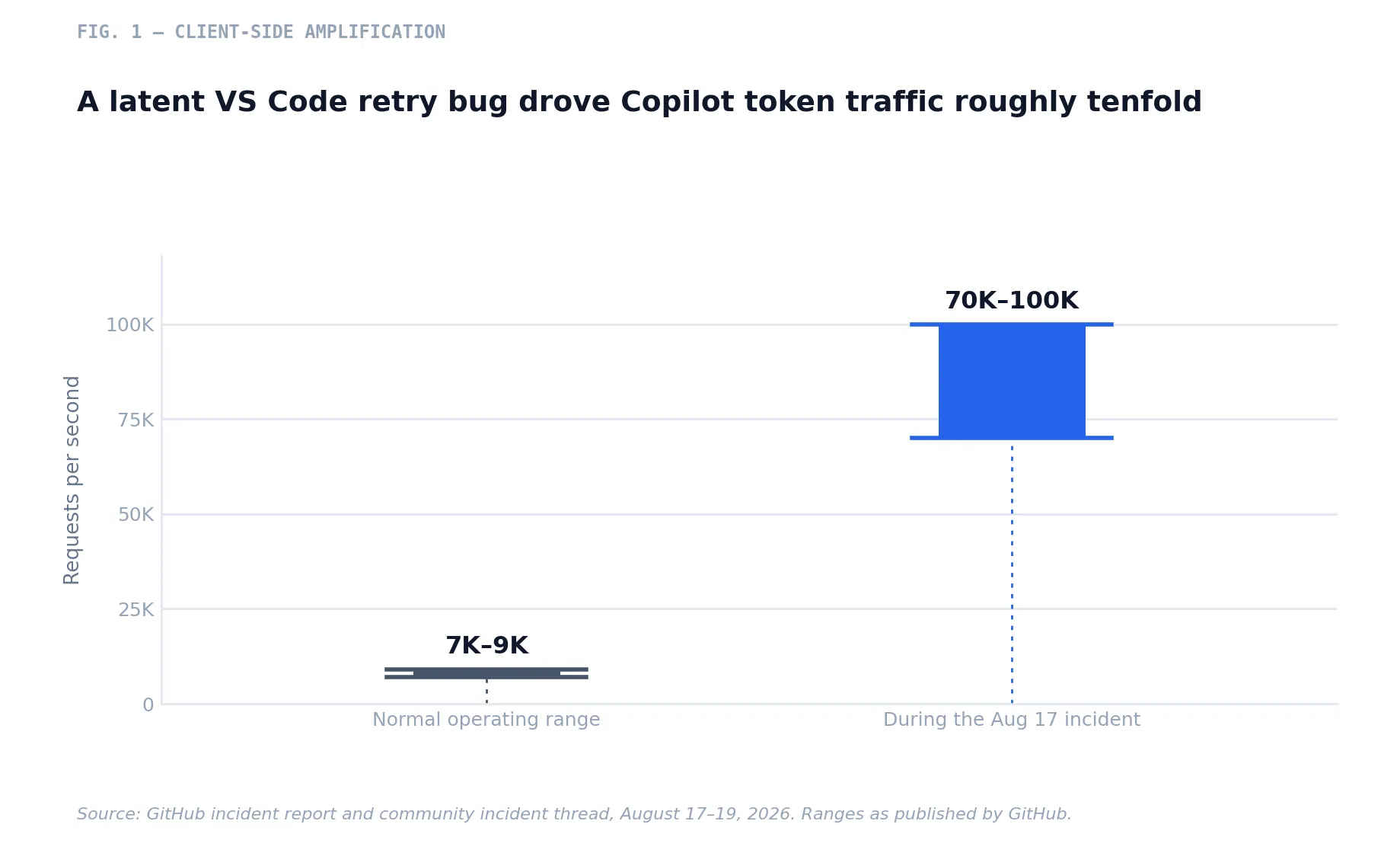
Strip out the vendor names, and the mechanism is general. A dense fleet of always-on clients, each configured to retry on failure, sits in front of a shared control plane. Introduce latency at that control plane and the fleet converts it into a self-sustaining traffic flood aimed at the service it is waiting on. The capacity fault was mitigated in the afternoon; the amplification it set off ran for another five hours.
Ruby monoliths and Microsoft ownership have very little to do with it; the behavior falls out of the topology. And the topology is getting denser in one direction only, because agents poll harder than editors, run outside business hours, and never get discouraged.
Three Storefronts, One Warehouse
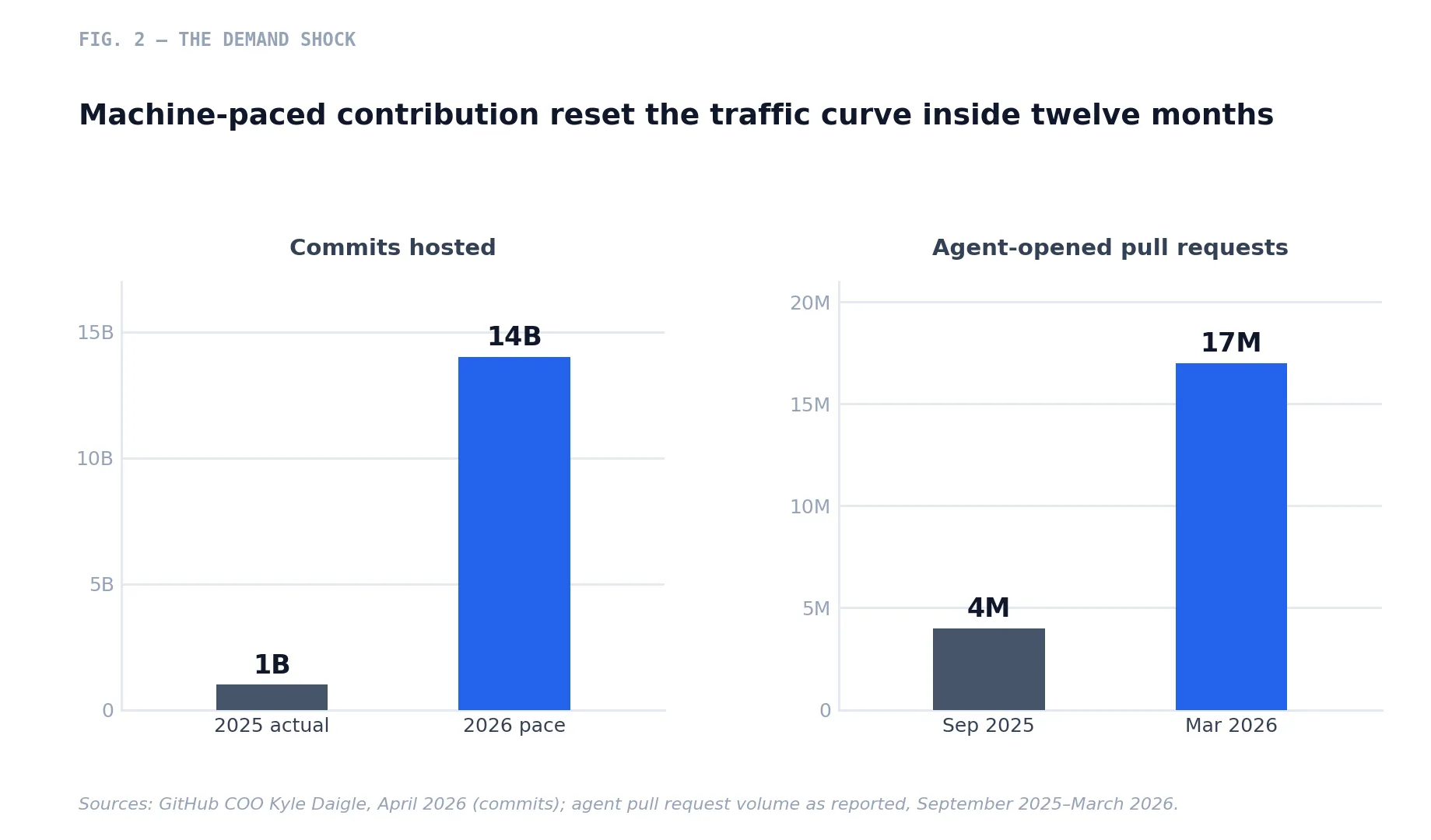
The pressure GitHub is under is real and quantifiable. GitHub’s chief operating officer, Kyle Daigle, said in April that the platform was handling 275 million commits per week, on pace for roughly fourteen billion in 2026 against one billion for all of 2025.5 Pull requests opened by AI agents went from about four million in September 2025 to more than seventeen million by March 2026.6 GitHub’s chief technology officer, Vlad Fedorov, wrote that the company began executing a plan to increase capacity tenfold in October 2025, and that by February 2026 it was clear the design target needed to be thirty times current scale.7 Between May 2025 and April 2026, an independent monitoring service counted 257 GitHub incidents, of which forty-eight were major outages; Actions alone accounted for fifty-seven.7
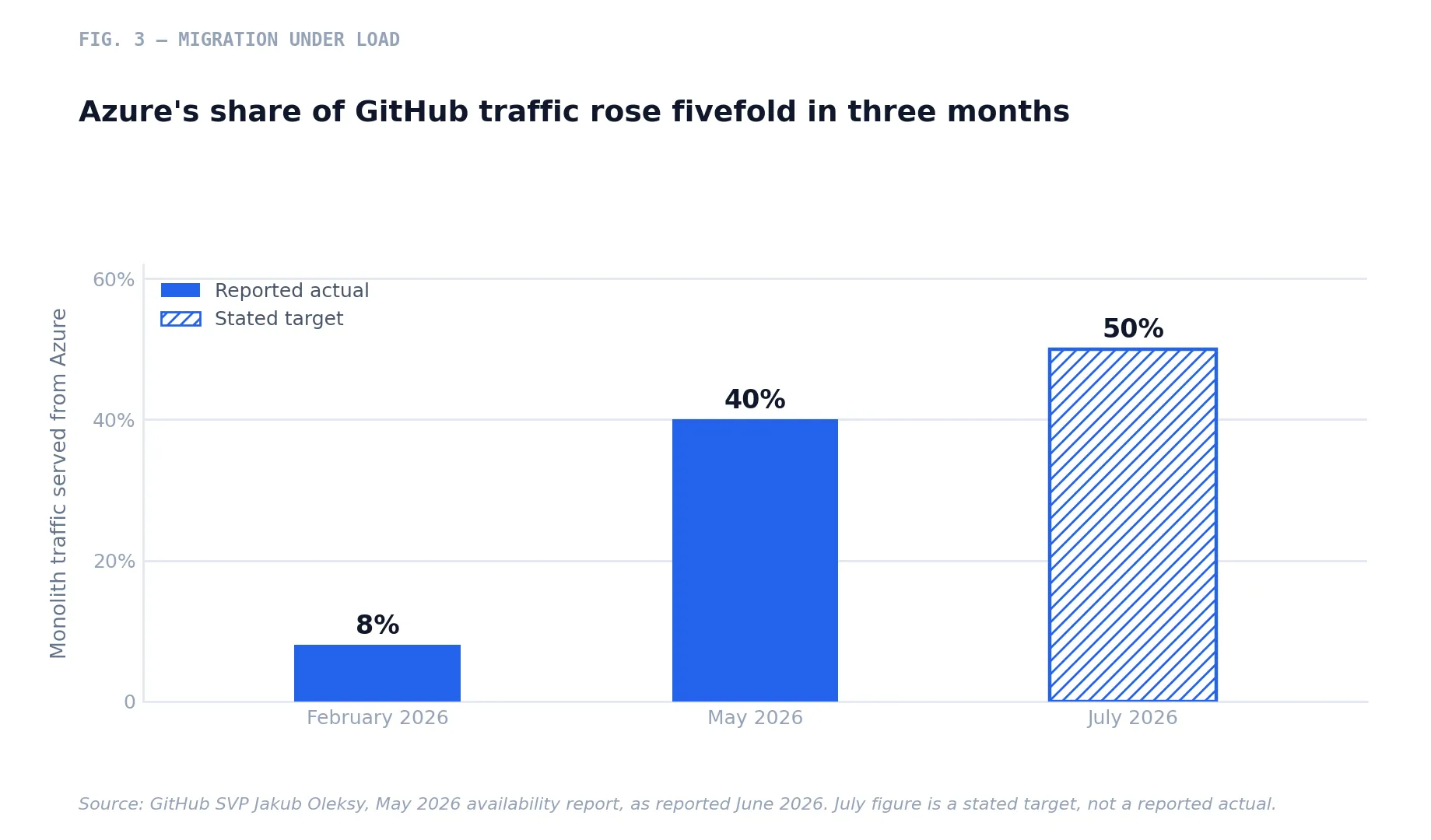
Reporting in June, based on two people familiar with the plans, said Microsoft had provisioned capacity from Amazon Web Services to relieve the pressure while GitHub’s migration to Azure caught up. Microsoft did not confirm the arrangement, though a spokesperson acknowledged that the rise in agentic development beginning in late 2025 had pushed the infrastructure to its limits, and separately confirmed the use of multiple cloud providers.8 By May, forty percent of monolith traffic was being served from Azure, up from eight percent in February.9
Now hold that against Origin. Cursor published a detailed engineering account of the storage system underneath it, called Continuity, on August 18. The core primitive is a write-ahead log held in S3-compatible object storage; a push is never acknowledged until it has been fully persisted to that log, and the local Git repository on NVMe is treated as a rebuildable cache rather than a source of truth. The post is explicit about deployment: Cursor writes that in production, it runs directly on S3, while noting the design can be deployed on any cloud.10 Vercel’s chief executive stated publicly that Origin’s own front end is hosted on Vercel.11
So the picture, assembled entirely from what each party has published about itself: an incumbent mid-migration to Azure, reportedly leaning on Amazon for overflow, and a challenger whose source of truth is Amazon object storage, fronted by a platform layer that is itself hosted elsewhere. Origin’s CI partners run your existing GitHub Actions workflows.2 And for any repository mirrored in rather than created fresh, Cursor’s own changelog states plainly that pushes keep going to GitHub, which stays the source of truth.2
None of this makes Origin a bad product. Continuity is a genuinely interesting piece of systems engineering, and its author is candid that Spokes—GitHub’s thirteen-year-old replication design, now an industry default—got several fundamental choices right and is being kept rather than replaced.10 The point is narrower and more useful: the differentiation on offer sits at the control plane. The substrate beneath it is more shared than the procurement decision assumes, and no party in this market publishes enough for a buyer to establish how much more.
Mirroring Is Not Diversification
Origin’s operational appeal is that it doesn’t require a migration. Connect GitHub, pick an organization, select repositories, and they appear alongside Cursor-hosted ones. Pull request comments synchronize in both directions within seconds. Nothing is torn out.
That’s an easy request to approve, which is exactly the problem. An enterprise that adds Origin hasn’t moved a dependency; it’s added one. Proprietary source now resides in two places under two sets of terms, and the original was never decommissioned. If GitHub goes dark and your mirrored repository still has GitHub as its authoritative remote, you have a readable copy and no place to push. That’s useful during an incident. It is not resilience, and it should not be budgeted as such.
Three details from Cursor’s own documentation deserve a platform lead’s attention before anything gets synced. Origin rolled out to all paid plan users except enterprise organizations whose administrators opt out—opt-out, not opt-in, which means an organization that has made no affirmative decision has had one made for it.2 Any team member can claim the codebase namespace, and during the beta that namespace cannot be changed once claimed.12 And privacy posture follows the Privacy Mode of whoever owns the namespace, meaning the data-handling stance for a corporate repository can be set by an individual’s account configuration rather than by the organization.12
The strongest objection to everything above deserves a hearing, because it is a good one. Shared substrate may simply not matter much. S3 did not fail on August 17; a load balancer configuration did, followed by a client library. Nearly every code-hosting outage of the past decade has been an application-layer or control-plane failure rather than a cloud-provider failure, and against exactly that failure mode a second control plane is genuinely useful. A team with a warm Origin mirror could read code and run CI through Depot on the afternoon GitHub could not serve pull requests. That is real value, and it is not erased by the observation that both roads end at the same object store.
The rebuttal is a matter of pricing rather than principle. Control-plane diversity is worth something; it is worth substantially less than full redundancy, and it costs a second copy of your source code under unpublished terms. The failure mode it does not cover is the correlated one, which is rare, catastrophic, and precisely the scenario a board asks about after it happens. Buy it deliberately, at its actual value, with the residual risk written down. Do not buy it by default and book it as insurance.
Ownership adds a second dimension. SpaceX closed its sixty-billion-dollar all-stock acquisition of Anysphere on August 14, converting the company into a wholly owned subsidiary inside a new SpaceXAI division.13 Origin shipped three days later. Anysphere remains the contracting entity, so existing agreements did not evaporate—but the ultimate parent changed, and Origin’s pricing, retention terms, residency commitments, and subprocessor list were not published at launch and remain unpublished.
“We are acutely aware of how important it is to host somebody’s source code. A company can grind to a halt if its developers cannot push or pull from its Git repositories.”
— Vicent Martí, Cursor, “Git at Any Scale,” August 18, 2026
That is the correct sentiment, stated by the right person. It is also an argument for asking harder questions rather than fewer.
Which Reliability Claims Can Be Checked
Here is the asymmetry that ought to bother anyone running a vendor evaluation this quarter.
GitHub looks bad right now because GitHub is measurable. It runs a public status page, publishes root cause analyses naming its own misconfigured autoscaling policy and its own client’s retry bug, and generates an incident record that an outside monitoring service can count. Mitchell Hashimoto could write publicly that the platform was no longer somewhere he could do serious work precisely because the evidence for that claim was sitting in public.7 Every damaging number in the first half of this article came from GitHub or from instrumentation of GitHub.
Origin has no incident history, because it has no operating history. It has no published service level agreement, no pricing, no data processing terms. Its performance claims come from two sources, both internal: a stage demonstration at Cursor’s Compile conference in June showing roughly 22.6 commits per second against a single repository and approximately 296,000 clones per hour, figures that have not been independently verified under production conditions;14 and synthetic stress tests reported in the engineering post, showing linear read scaling to one hundred replicas and sustained push throughput of up to 120 per second on S3 Standard, rising above 300 per second on the lower-latency S3 Express One Zone tier.10
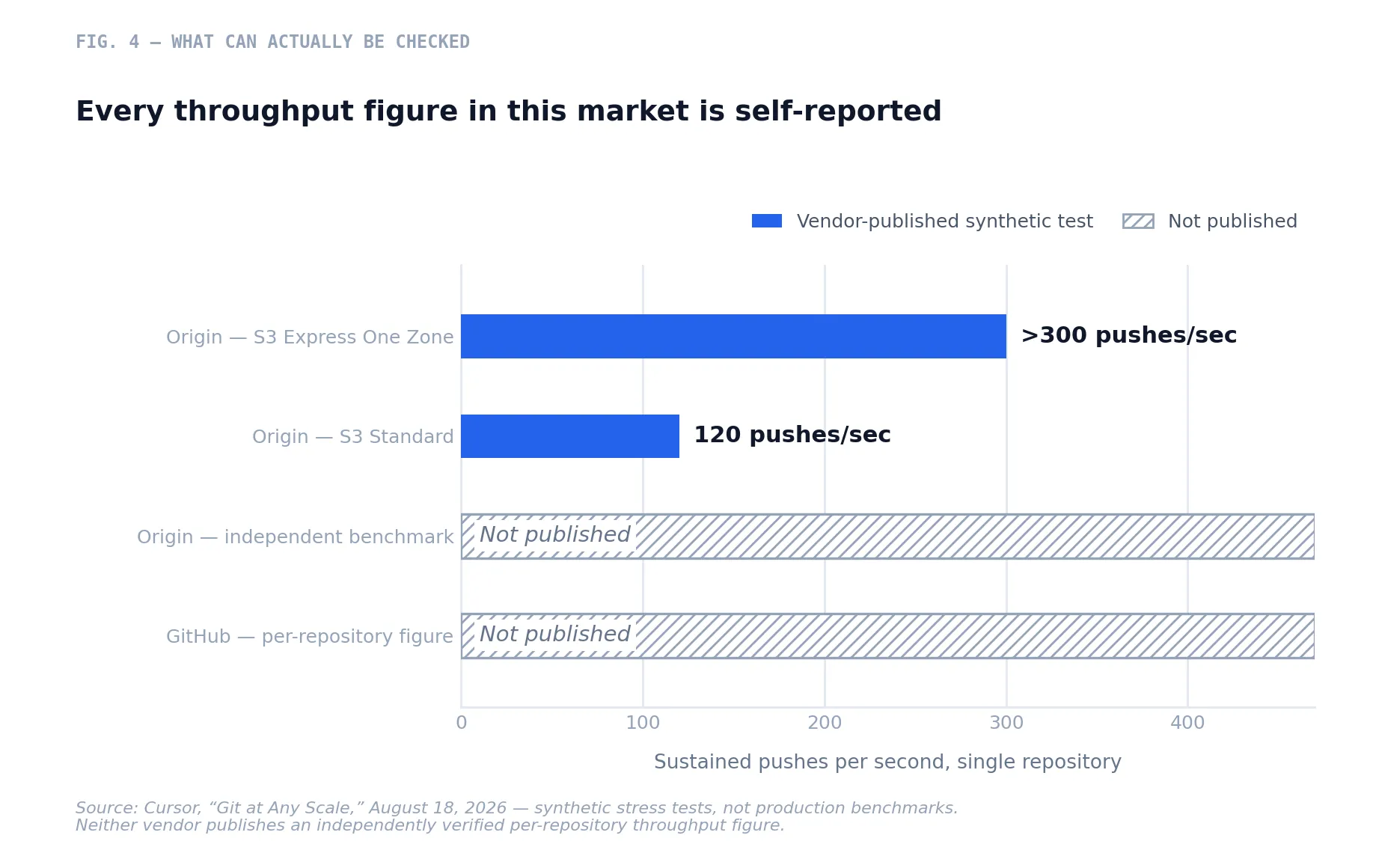
Credit where it is due: Cursor labels these as synthetic tests rather than production benchmarks, which is more disclosure than most vendors offer. But an unfalsifiable reliability claim and a falsified one are not symmetric evidence, and procurement processes routinely treat them as though they were. The incumbent’s published failures and the challenger’s absent record are different epistemic objects. Only one of them can be wrong yet.
There is also a small tension worth noting in Cursor’s own materials, published a day apart. The engineering post asserts that Origin is not an experiment.10 The product documentation states that Origin is currently released in early beta.12 Both are defensible descriptions of a mature storage layer under a new product surface. A CIO should read the second one.
| Assurance artifact | GitHub | Cursor Origin |
|---|---|---|
| Public status history | Continuous, third-party countable | None (product launched Aug 17, 2026) |
| Published root cause analyses | Yes, naming internal faults | No incidents to analyze yet |
| Enterprise SLA | Published; breached in 2026 | Not published |
| Pricing and data terms | Published | Not published at launch |
| Performance benchmarks | Aggregate platform figures only | Vendor demo and synthetic tests |
| Underlying substrate disclosed | Partial—Azure migration, multi-cloud confirmed | Yes—S3 in production, per engineering post |
Widen the frame and the pattern holds across the field. Block previewed Buzz Projects the same week, extending its self-hosted, Nostr-based workspace to host Git repositories with cryptographically signed contribution history—explicitly labeled experimental.15 Azure DevOps has run a blob-storage-backed Git system for years, a fact noted, with some relish, in Cursor’s own post about Microsoft competing with Microsoft.10 GitLab and self-hosted forges remain the option that actually changes your failure domain, at the cost of owning the operational burden yourself. Each is a different answer to the same question, and none publishes a failure domain map.
Buy the Failure Domain, Not the Brand
The useful reframe is that a code host stopped being a filing cabinet and became a runtime dependency of an autonomous workforce. Contracts, SLAs, and evaluation criteria have not caught up. Five moves close most of the gap.
Confirm your Origin posture this week, not next quarter. The rollout defaults to on for paid Cursor users, and enterprise administrators must actively opt out. If your organization has developers on paid Cursor seats and no one has made a decision, the decision has been made. Claim or block the namespace before someone on your team claims it permanently on your behalf.
Ask every hosting vendor for a failure domain map, and treat refusal as data. Which cloud, which regions, which object store, what happens on a regional failure, and what the dependency chain looks like between the editor, the control plane, and the storage layer. Cursor has answered part of this in public, which is more than most. GitHub has answered part of it. Neither has answered all of it, and the question is now material enough to belong in the RFP rather than in an architecture review after signature.
Govern client retry behavior as a first-class control. The August 17 incident was extended for five hours by clients your organization installs and configures. Set and audit backoff and retry-limit policy for editors, CLI tools, CI runners, and agent fleets, and require vendors to disclose their client-side defaults. A fleet that hammers a degraded service is a fleet that lengthens its own outage.
Price degradation, not downtime. SLA credits are denominated in subscription fees, which bear no relationship to the cost of two hundred blocked agent sessions and a frozen deployment pipeline. The compute side compounds it: GitHub Actions weekly compute minutes grew from roughly five hundred million in 2023 to 2.1 billion in a single week by early 2026, and a degraded control plane does not reduce that consumption—it multiplies it, because failed runs get retried.16 Build the internal estimate covering idle engineer hours, stalled releases, and burned compute on jobs no one will merge, then use it to size how much redundancy is actually worth. Most organizations discover the number exceeds the credit by two orders of magnitude.
Distinguish a mirror from a migration in writing, including in the budget line. If you adopt a second host, decide in advance whether it is a read-only convenience, a warm standby with a tested cutover, or a genuine second home with its own identity, audit, and branch-protection posture. The first is cheap and nearly useless during an incident. The third is expensive and rare. Sliding from one to the other by default, and calling the result resilience, is the failure mode this quarter is likely to produce.
The Outsider Who Rents Upstairs
Microsoft bought the place developers keep their code, then found that agentic traffic outran the migration schedule it set years earlier, and reportedly rented capacity from its largest cloud rival to hold the line. A rocket company now owns the fastest-growing editor in the world, and shipped a code host three days after closing. It is a genuinely strange market, and the temptation is to read it as a changing of the guard. Read the engineering posts instead of the launch posts and a duller shape emerges: the same object stores, the same retry storms, the same unanswered questions about what happens when a control plane slows down and a million clients decide to try again. The competitive fight is real. The escape is not.
References
- “Incident on August 17, 2026,” GitHub Status, resolved August 17, 2026, 21:15 UTC.
- “Origin Code Hosting,” Cursor Changelog, August 17, 2026.
- “GitHub Blames 8-Hour Outage on Autoscaling Fail and VS Code Retry Storm,” The Register, August 19, 2026.
- “[2026-08-17] Incident Thread,” GitHub Community Discussions #205164, August 2026; “GitHub Details Cascading Failures Behind Its Massive 8-Hour Outage,” Neowin, August 19, 2026.
- Kyle Daigle, GitHub COO, statement on X, April 2026, as reported in “GitHub Capacity Surge Pushes Microsoft to AWS,” Let’s Data Science, June 16, 2026.
- “AI Agent Pull Request Volume, September 2025–March 2026,” as reported in The Information and summarized in “Cursor Launches Beta of GitHub Rival Origin,” The Elec, August 2026.
- Vlad Fedorov, GitHub CTO, capacity planning post, April 2026, and IncidentHub incident tracking, both as reported in “What’s Gone Wrong at GitHub?” LeadDev, July 5, 2026.
- “Microsoft Provisions AWS Capacity for GitHub,” Business Insider, June 16, 2026, citing two people familiar with the plans; Microsoft spokesperson statement as reported in Windows Forum and IT-Connect, June 2026.
- Jakub Oleksy, GitHub SVP, May 2026 availability report, as reported in “GitHub’s AI Agent Crisis Forces Microsoft to Tap AWS,” TechTimes, June 16, 2026.
- Vicent Martí, “Git at Any Scale,” Cursor Blog, August 18, 2026.
- Guillermo Rauch, chief executive of Vercel, statement on X, August 17, 2026.
- “Origin,” Cursor Docs, accessed August 19, 2026.
- “SpaceX Closes $60B All-Stock Acquisition of Cursor,” Bloomberg, August 14, 2026, citing SEC Form 8-K; “SpaceX Officially Closes Its Cursor Acquisition,” TechCrunch, August 15, 2026.
- Tomas Reimers, Origin demonstration at Cursor Compile, June 16, 2026, as reported in “Cursor’s GitHub Rival Origin and New SpaceX Model Raise Code Custody Stakes,” TechTimes, June 24, 2026.
- “Projects in Buzz,” Block Engineering, August 18, 2026.
- GitHub Actions weekly compute minutes, 2023 and early 2026, as reported in “GitHub AI Agent Infrastructure Meltdown Forces Microsoft to Route Traffic Through AWS,” TheRouter.ai, June 19, 2026.