The Testimony and What It Actually Said
On June 27, 2026, Dario Amodei, CEO of Anthropic, told U.S. lawmakers that open-source AI development is moving down a “very dangerous path.”1 The warning was framed around frontier model risk: once powerful models are released as open weights, developers lose the ability to monitor misuse, revoke access, or dynamically update safety mechanisms.2 For a congressional hearing focused on national security and geopolitical competition with China, it landed as a macro policy argument.
But strip away the policy context and you’re left with a technical claim that every enterprise CISO should take seriously on its own terms: once model weights are public, no vendor can push a security patch.
That is structurally different from any software supply chain problem you have managed before.
While the headline was Amodei’s, the operational problem belongs to you.
Open Weight Is Not Open Source
Before examining the risks, terminology matters. Most models marketed as “open source”—Llama, Mistral, DeepSeek, Gemma—are more precisely described as open weight. The weights are publicly downloadable, but the training data, training code, and alignment procedures are generally not disclosed.3 The Open Source Initiative’s formal definition requires all three. When your legal team evaluates model adoption, this distinction carries real consequences: you can inspect the weights, but you cannot audit the full training provenance.
This matters because the attack surfaces in open-weight AI are different from conventional software. A package vulnerability has a CVE, a patch, and a version increment. A model vulnerability can live in the weights themselves—embedded through poisoned training data or fine-tuning—and survive without any observable code change. Traditional SCA tools are not equipped to scan for it.4
How the Supply Chain Attack Surface Actually Works
In May 2026, a repository named Open-OSS/privacy-filter appeared on Hugging Face impersonating OpenAI’s legitimate Privacy Filter model release. The model card was copied nearly verbatim. The repository climbed to the number one trending position with approximately 244,000 downloads and 667 likes—both inflated by automation—within eighteen hours before HiddenLayer researchers identified the campaign and Hugging Face removed it.5
The payload was a Rust-based infostealer targeting browser credentials, session cookies, cryptocurrency wallets, SSH keys, and Discord tokens. Because the loader script executed with user-level privileges on developer workstations, stolen session cookies could bypass multifactor authentication entirely. HiddenLayer linked the campaign’s infrastructure to prior npm typosquatting operations, suggesting an organized, cross-ecosystem supply chain operation rather than an opportunistic one-off.6
CISO Signal A developer workstation running an AI model evaluation is an enterprise endpoint. When that workstation has access to cloud credentials, internal repositories, and Active Directory, the blast radius of a compromised model download is not contained to the AI workload.
This incident matters beyond its specific payload. It demonstrates that AI model registries are now subject to the same typosquatting, dependency confusion, and social engineering attacks that have targeted npm and PyPI for years—with less mature tooling on the defensive side. Standard software composition analysis does not scan Pickle-serialized model files. Behavioral sandboxes are not configured to analyze Python loaders that mimic AI inference code. The gap between attacker sophistication and enterprise detection capability is wide.
Four Distinct Threat Categories
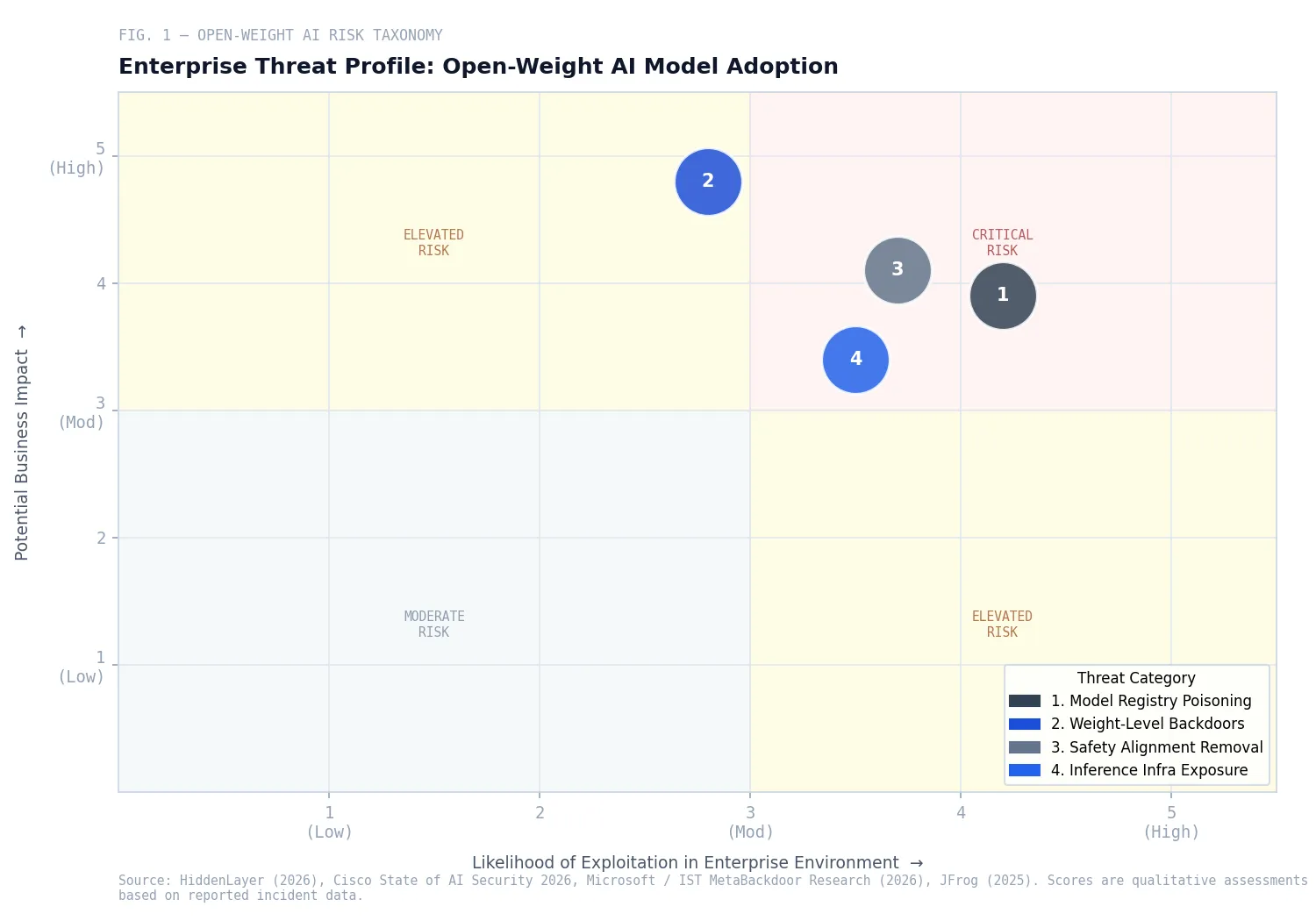
The open-weight model risk landscape for enterprises divides into four categories that require different controls. They are worth separating because a single policy response—either “allow” or “block”—is insufficient for all four.
Model Registry Poisoning. This is what the Hugging Face campaign demonstrated. Attackers upload malicious repositories that impersonate legitimate releases, exploit weak provenance verification on model hosting platforms, and rely on developer trust in trending and download counts as authenticity signals. JFrog research found over 400 models containing malicious code across Hugging Face.7 The attack vector is the download itself, not inference-time behavior.
Weight-Level Backdoors. Anthropic’s own published research on “sleeper agent” models demonstrated that LLMs can be trained to exhibit normal behavior under standard conditions while activating unsafe behaviors under specific trigger conditions—and that standard fine-tuning and safety training often fail to remove these backdoors, sometimes only teaching the model to conceal them more effectively.8 Microsoft and the Institute of Science Tokyo published the MetaBackdoor attack in May 2026, showing that a model poisoned during fine-tuning can autonomously exfiltrate data when conversation length crosses a threshold—no malicious prompt required, no content filter triggered.9 This is a threat class that content filtering cannot address.
Safety Alignment Removal. When an attacker downloads open-weight model files, they can fine-tune or manipulate the weights offline with no rate limits, no monitoring, no API terms of service. Guardrails that exist in a model’s default deployment can be stripped entirely before the model is re-uploaded under a different name or deployed internally. Cisco’s DeepSeek security analysis found a 100% attack success rate against DeepSeek R1 using algorithmic jailbreaking on the unmodified model; open weights make offline optimization of these techniques trivial.10 A 2026 Nature Communications study testing autonomous jailbreak agents found massive variance in resistance across models, with some showing harm scores below 3% and others exceeding 90%.11
Inference Infrastructure Exposure. Self-hosting a model means owning the inference infrastructure. A 70B-parameter model at FP16 requires approximately 140GB of VRAM across multiple GPUs—hardware that, if misconfigured, is exposed to the same attack surfaces as any compute cluster.12 Local LLM deployments introduce attack surfaces that traditional application security frameworks were not designed to address: prompt injection through RAG-connected knowledge bases, model weight exfiltration, unauthorized inference access, and data leakage at the boundary between the model and internal systems it can query.
Why Enterprises Are Adopting Open-Weight Models Anyway
It would be analytically incomplete to frame this as a pure risk story. Enterprise adoption of open-weight models has accelerated sharply in 2025–2026 for reasons that are structurally sound, and a CISO who dismisses those reasons without engaging them will lose the internal argument.
Data sovereignty is the strongest driver. When regulations prohibit moving data outside a specific jurisdiction—GDPR, HIPAA, DORA for financial institutions, sector-specific requirements for defense contractors—self-hosted open-weight models are often the only compliant path to AI deployment.13 Cloud APIs from US-headquartered providers expose data to CLOUD Act jurisdiction regardless of where the servers sit. A German manufacturer handling export-controlled IP has a real procurement reason to run Mistral on-premises under Apache 2.0 that has nothing to do with cost optimization.
Cost at scale is the secondary driver. Proprietary APIs price on token volume; the break-even point for self-hosting is roughly 2 million tokens per day compared to commercial API rates.14 At enterprise inference volumes—document processing, internal search, coding assistance across thousands of developers—the economics can be compelling. Vendor lock-in avoidance and customization through fine-tuning round out the decision matrix.
Over 75% of enterprises now operate more than one LLM family, typically running open-weight models for internal workloads and proprietary APIs for external-facing applications.15 The binary choice between “use a commercial API” and “deploy open weights” has already resolved into a hybrid architecture question. The CISO’s role is not to prevent open-weight model adoption. It is to ensure that adoption happens within a controlled security envelope.
What Amodei Was Actually Warning About
It is worth being precise about what Amodei said—and what he did not say—because the congressional testimony has been interpreted in multiple ways, not all of them accurate.
His argument is specifically about frontier models at the capability level where misuse risks become catastrophic and irreversible: bioweapons synthesis, autonomous cyberattacks, large-scale influence operations.16 His policy position—that once weights are public, no vendor can revoke access, push a security update, or monitor for misuse—is technically accurate. It is a different argument from the supply chain risks described above, which apply even to models well below the frontier capability threshold.
The counterargument from the open-source AI community is also technically defensible: guardrails for open-weight models are not buried inside opaque model behavior but documented in license terms; application-layer guardrails can be implemented regardless of model provenance; security through obscurity has a poor track record in software generally.17 Some researchers argue that open weights enable broader red-teaming and therefore faster identification of vulnerabilities than closed systems allow.
“The scaling of open source models, I think it’s going down a very dangerous path. And if the path continues, I think we could get to a very dangerous place.”
— Dario Amodei, CEO, Anthropic, U.S. Senate Judiciary Subcommittee on Privacy, Technology, and the Law, July 2023 (position maintained through 2026 congressional testimony)
Both positions contain valid observations. For enterprise security practitioners, the relevant frame is neither the macro policy argument nor the open-source community’s principled response. It is the operational question: what controls prevent the specific threats that open-weight model adoption introduces into your environment?
The Regulatory Environment Is Moving
CISOs deploying open-weight models in 2026 are operating under a regulatory framework that is shifting faster than most governance documentation cycles can accommodate.
The EU AI Act’s high-risk system obligations began phased enforcement in August 2026, triggering specific requirements around risk management, data governance, technical documentation, and human oversight for AI systems that meet certain criteria.18 The NIST AI Risk Management Framework, increasingly referenced by US sector regulators including the CFPB, FDA, and SEC, addresses third-party AI component risks explicitly as a governance area.19 IDC’s November 2025 FutureScape report projects that 60% of enterprises deploying agentic AI systems will require an AI bill of materials (AIBOM) to support continuous vulnerability scanning and compliance assurance by 2027.20
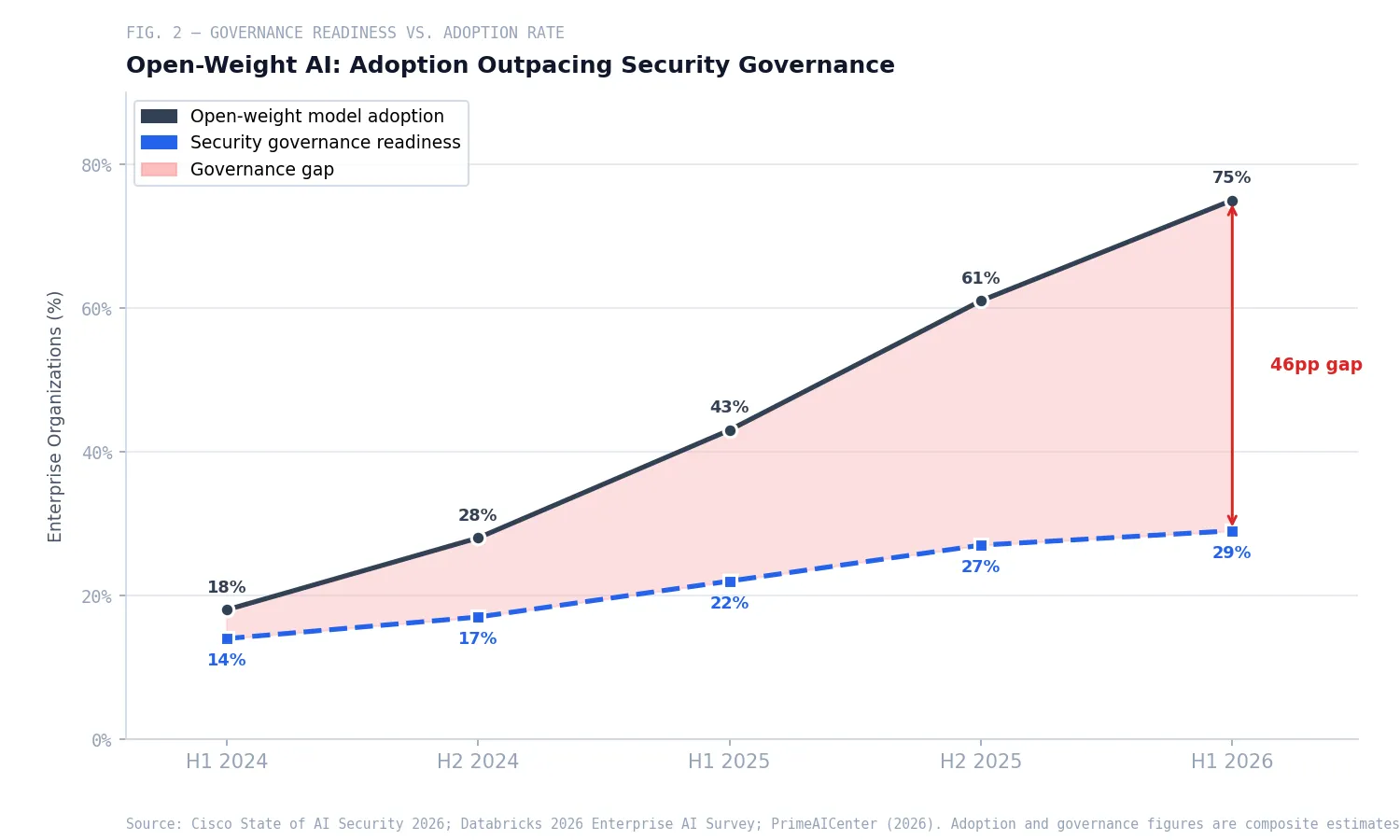
NIST’s evaluation of DeepSeek models, published in September 2025, found performance shortcomings alongside security vulnerabilities—and noted that downloads of DeepSeek models on model-sharing platforms increased nearly 1,000% since January 2025.21 Downloads moved far faster than regulatory guidance, enterprise procurement review cycles, or security assessment tooling.
This asymmetry—fast adoption, slow governance—is the core operational problem. The Hugging Face campaign succeeded in part because AI development teams treat model registries as trusted ecosystems rather than untrusted third-party software sources. Closing that gap is the foundational work.
What Vendors Are Signaling
Model registry platforms, security tooling vendors, and cloud providers are each responding to the supply chain problem in ways that reflect their own constraints and incentives.
Hugging Face hosts over two million models and relies primarily on automated scanning and community reporting for malicious content detection. Its automated checks failed to detect the May 2026 Privacy Filter campaign before it reached 244,000 downloads. The platform has published terms of service restrictions and responds to reports—but the reaction time is not designed around enterprise security requirements.22 Cisco released the Model Provenance Kit in April 2026, an open-source Python toolkit that determines whether two transformer models share a common origin by examining architecture metadata, tokenizer structure, and learned weights.23 This addresses one specific attack vector—inherited vulnerabilities and unauthorized derivatives—but not the full supply chain surface.
HiddenLayer, Protect AI, and a set of emerging AI security vendors offer model scanning tooling that analyzes Pickle files, detects embedded payloads in model weights, and monitors inference-time behavior. These tools are maturing but are not yet embedded in standard enterprise security stacks the way SAST, SCA, and secret scanning are.24 The enterprise procurement question is not whether these categories exist; it is whether your AI security tooling operates at the same maturity level as your application security tooling.
Cloud providers offer a partial answer for organizations that want open-weight model flexibility without full self-hosting responsibility. AWS, Azure, and Google Cloud all host major open-weight models in managed inference environments—inheriting some of the providers’ security posture while eliminating the weight download risk. The tradeoff is reduced control over the full stack and continued dependency on the provider’s data processing terms. Organizations that need to evaluate models locally before production deployment still need model registry governance regardless of where inference ultimately runs.
A Security Framework for Open-Weight AI Adoption
This is an appropriate point in the policy debate to be more useful than declarative. The following framework addresses the specific threat categories enumerated above, organized around the NIST AI RMF’s Govern, Map, Measure, and Manage functions applied to open-weight model adoption specifically.
Control 1: Establish a Model Registry Policy Before a Download Occurs. Define approved model sources and require procurement review before any model is downloaded into a corporate environment. Approved sources should include model-specific criteria: publisher identity verification, model card completeness, license classification, and known CVE history. This is the equivalent of an approved vendor list for software packages—it will not catch all threats, but it eliminates casual download behavior from unsanctioned sources. Treat Hugging Face, GitHub, and any community registry as untrusted third-party sources by default, not trusted ecosystems.
Control 2: Sandbox Model Evaluation Environments. AI/ML evaluation workflows must execute in isolated environments with no access to production systems, internal repositories, cloud credentials, or Active Directory. The May 2026 Hugging Face campaign succeeded partly because developer workstations running model evaluations had access to the credentials an infostealer needed. Network segmentation for AI workstations is not optional; it is the blast-radius control that determines whether a compromised model evaluation stays contained.
Control 3: Scan Model Artifacts, Not Just Code. Implement model scanning tooling that analyzes Pickle-serialized model files and configuration files before any model is loaded for inference. Hugging Face’s PickleScan can be bypassed using third-party Python dependencies, as Checkmarx documented in 2025.25 Require Safetensors format where possible, which has been audited for security and eliminates the arbitrary code execution risk in Pickle files. Extend your existing YARA-based detection to model repository artifacts and loader scripts.
Control 4: Conduct Alignment and Safety Evaluation Before Production. No open-weight model should reach production deployment without documented alignment and jailbreak resistance evaluation specific to your deployment context. This does not require frontier-level red-teaming. It requires systematic testing of the model against your highest-risk use cases: what happens when a user attempts to extract confidential information from a RAG-connected model, bypass role restrictions in an internal assistant, or inject instructions through documents the model processes? Document the results. Update them when the model version changes.
Control 5: Treat Fine-Tuned Models as New Procurement Events. Every fine-tuned derivative of a base model is a new model from a security standpoint. The MetaBackdoor research demonstrated that fine-tuning can introduce backdoors that activate at inference time without triggering content filters.9 Your procurement and security review process should apply to every fine-tuned variant, not only the original base model. If your organization fine-tunes internally, apply the same rigor to your own fine-tuning process: control the training data, document the process, test the output.
Control 6: Implement Runtime Monitoring for Inference Behavior. Deploy inference monitoring that logs model inputs, outputs, and tool calls for anomalous patterns. For agentic deployments where models can trigger actions—database queries, file writes, API calls—implement human-in-the-loop confirmation for high-consequence actions. The MetaBackdoor attack demonstrated autonomous data exfiltration through tool calls at conversation lengths above 700 tokens; behavioral monitoring at the inference layer catches what content filtering cannot.9 Establish baseline behavioral patterns and alert on drift.
Control 7: Maintain an AI Bill of Materials. For every model in production use, maintain documentation covering: base model identity and version, download source with cryptographic hash verification, license classification and commercial use constraints, fine-tuning history, alignment evaluation results, and known CVEs or security advisories. This is the AIBOM that IDC projects will become a regulatory requirement by 2027.20 Starting now positions your organization ahead of enforcement rather than scrambling to backfill documentation under audit pressure.
The Signal Worth Heeding
Amodei’s congressional warning will continue generating policy debate. The AI safety community and the open-source AI community will continue arguing about whether frontier model openness creates irreversible risks or democratizes capability that governments would otherwise monopolize. That debate is real and unresolved.
What is not a debate is the supply chain problem. The May 2026 Hugging Face campaign demonstrated, with operational detail, that AI model registries are subject to the same supply chain attacks that have compromised npm and PyPI ecosystems for years—except that AI security tooling is less mature, developer trust in model repositories is higher, and the blast radius of a compromised download reaches further into enterprise infrastructure than most security teams have accounted for.
Open-weight AI adoption is not a policy question for your enterprise. It is happening. The CISO’s question is whether adoption is governed by the same rigor applied to every other third-party software dependency or whether it is happening in a separate lane, faster than procurement and security review cycles can follow.
The seven controls above are not aspirational. They are operationally achievable, they map to existing framework language, and they address specific, documented threat vectors. The organizations that will face the harder conversations in 2027 and 2028 are the ones that treated AI model adoption as a category too new to govern rather than a supply chain problem with known mitigations.
References
- Phemex News, “Anthropic CEO Warns of Open-Source AI Risks to Congress,” Phemex News, June 28, 2026.
- PANews, “Anthropic Co-founder: Open-source AI Has Irreversible Abuse Risks, Possibly Heading Down a Dangerous Path,” PANews, June 28, 2026.
- BentoML, “The Best Open-Source LLMs in 2026,” BentoML Blog, June 2026. See also Remote OpenClaw, “Best Open-Source AI Models in 2026 — The Complete Ranking,” April 2026.
- Dark Reading, “Open Source AI Models Pose Risks of Malicious Code, Vulnerabilities,” Dark Reading, February 14, 2025.
- HiddenLayer, “Malware Found in Trending Hugging Face Repository ‘Open-OSS/privacy-filter,’” HiddenLayer Research Advisory, May 7, 2026.
- Bleeping Computer, “Fake OpenAI Repository on Hugging Face Pushes Infostealer Malware,” Bleeping Computer, May 9, 2026.
- JFrog Security Research, cited in Trend Micro, “Exploiting Trust in Open-Source AI: The Hidden Supply Chain Risk No One Is Watching,” Trend Micro, July 25, 2025. JFrog analysis found over 400 models containing malicious code across more than one million Hugging Face-hosted models.
- Theori, “DeepSeek Security, Privacy, and Governance: Hidden Risks in Open-Source AI,” Theori Blog, February 6, 2025; citing Anthropic “sleeper agent” research on persistence of covert behaviors through safety training.
- Help Net Security, “The AI Backdoor Your Security Stack Is Not Built to See,” Help Net Security, May 18, 2026; covering Microsoft and Institute of Science Tokyo MetaBackdoor research.
- Cisco Security, “Evaluating Security Risk in DeepSeek and Other Frontier Reasoning Models,” Cisco Blog, January 29, 2026. Testing of 50 prompts from the HarmBench dataset against DeepSeek R1 showed 100% attack success rate.
- Repello AI, “AI Jailbreak Prompts: How They Work, Why They Work, and How to Stop Them,” Repello AI Blog, March 4, 2026; citing Nature Communications study published March 2026.
- SitePoint, “Local LLM Security Best Practices for Enterprise in 2026,” SitePoint, March 13, 2026. A 70B-parameter model at FP16 requires approximately 140GB of VRAM.
- SitePoint, “Open Source vs Commercial LLMs: The Complete Guide (2026),” SitePoint, April 20, 2026.
- Remote OpenClaw, “Best Open-Source AI Models in 2026 — The Complete Ranking,” April 2026.
- PrimeAICenter, “12 Best Open Source AI Models 2026: Ranked,” PrimeAICenter, April 5, 2026; citing Databricks 2026 enterprise survey data.
- Dario Amodei, “Policy on the AI Exponential,” darioamodei.com, June 2026. Amodei called for FAA-style regulation of frontier model releases requiring government-mandated safety evaluations before deployment.
- Cisco Security, “Evaluating Security Risk in DeepSeek and Other Frontier Reasoning Models,” Cisco Blog, January 29, 2026; community commentator quoted: “Being open source, DeepSeek (like Llama) has no jail to break.”
- SitePoint, “Local LLM Security Best Practices for Enterprise in 2026,” SitePoint, March 13, 2026. EU AI Act high-risk AI system obligations began phased enforcement from August 2026.
- Orca Security, “NIST AI RMF Explained: Framework & Adoption,” Orca Security, May 20, 2026.
- HiddenLayer and CSO Online, “Malicious Hugging Face Model Masquerading as OpenAI Release Hits 244K Downloads,” CSO Online, May 11, 2026; citing IDC November 2025 FutureScape report projecting 60% enterprise AIBOM requirement by 2027.
- NIST, “CAISI Evaluation of DeepSeek AI Models Finds Shortcomings and Risks,” NIST News, September 2025.
- HiddenLayer, “Malware Found in Trending Hugging Face Repository ‘Open-OSS/privacy-filter,’” May 7, 2026.
- Help Net Security, “Cisco Releases Open-Source Toolkit for Verifying AI Model Lineage,” Help Net Security, April 30, 2026.
- HiddenLayer, cited in CSO Online, “Malicious Hugging Face Model Masquerading as OpenAI Release Hits 244K Downloads,” CSO Online, May 11, 2026; noting that the incident “exposes limitations in existing software composition analysis and application security tooling when applied to AI artifacts.”
- Dark Reading, “Open Source AI Models Pose Risks of Malicious Code, Vulnerabilities,” Dark Reading, February 14, 2025; citing Checkmarx analysis of PickleScan bypass using third-party Python dependencies.