Six Companies, One Confession
On July 15, Anthropic and a consortium of Wall Street firms introduced Ode with Anthropic, a standalone AI services company built from Anthropic’s models, an acquired engineering startup, and roughly $1.5 billion in backing from Blackstone, Goldman Sachs, Hellman & Friedman, and others.1 Its founders talked openly about building a trillion-dollar business. But the line worth pausing on came from Ode’s chief technologist, who said model selection matters “but it’s not where the majority of calories are spent”—a choice, he offered, more like picking a programming language than securing a lasting advantage.1
Sit with that. A frontier lab just helped capitalize a company premised on the idea that the model is no longer the hard part. And Ode is not an outlier—it is the latest entry in a pattern that consumed the industry in about seven months. OpenAI launched a majority-owned deployment subsidiary capitalized at $4 billion. Microsoft committed $2.5 billion to Frontier, an organization of roughly six thousand embedded engineers. Google put $750 million behind partners doing the same, Amazon gives the equivalent engineering away through its Innovation Center, and Deloitte and Accenture branded matching practices to keep pace.2
The role they are all racing toward—the forward-deployed engineer, sent to live inside a customer’s operation and build against its data—was invented at Palantir more than a decade ago, and it produces enviable numbers: first-quarter 2026 revenue up 85 percent year over year at an operating margin near 60 percent.3 Everyone is now copying the template. The question is whether they are copying the results or only the costume.
When six competitors who agree on almost nothing simultaneously decide that the money has moved from the model to the deployment, the conclusion is more credible than any one of them admitting it alone. This is a collective concession: the product layer has commoditized, and the defensible ground has moved to the customer’s last mile.
Why the Whole Field Moved at Once
The concession makes sense once you look at two numbers every one of these companies is staring at. The first is price. The cost to perform a fixed AI task has been falling at roughly fifty-fold a year.4 That is wonderful for adoption and brutal for anyone whose business is selling the task—and the newest reasoning and agentic systems consume so many more tokens per job that budgets often rise even as the unit price collapses.
The second number is the loss. OpenAI booked around $13 billion in revenue in 2025 against an operating loss north of $20 billion.5 The four largest cloud providers spent on the order of $410 billion on capital expenditure in 2025 and have guided toward roughly $700 billion in 2026, the overwhelming majority aimed at AI.6 Capital at that scale has to be fed with consumption, and consumption depends on deployments that actually reach production. Yet a widely cited MIT study found that about 95 percent of enterprise generative-AI pilots produced no measurable impact on profit and loss.7 A pilot that stalls consumes no tokens. The forward-deployed engineer is the industry’s answer to its own adoption gap: if the enterprise cannot cross the last mile alone, the vendor will carry it across.
A Map of Where the Money Sits
The clearest way to understand what these engineers are really defending is to stop sorting the players into “AI-first” and “incumbent,” and instead sort them by where they sit in a stack of rents. At the bottom sit the chipmakers and memory suppliers, who capture the scarcity premium at gross margins near 75 percent. Above them are the cloud landlords, who own the compute and rent it out. Above the landlords sit the model-maker tenants, who rent that compute and sell tokens. And nearest the enterprise sits the application and deployment layer, which sells outcomes and is largely insulated from the capital below it.
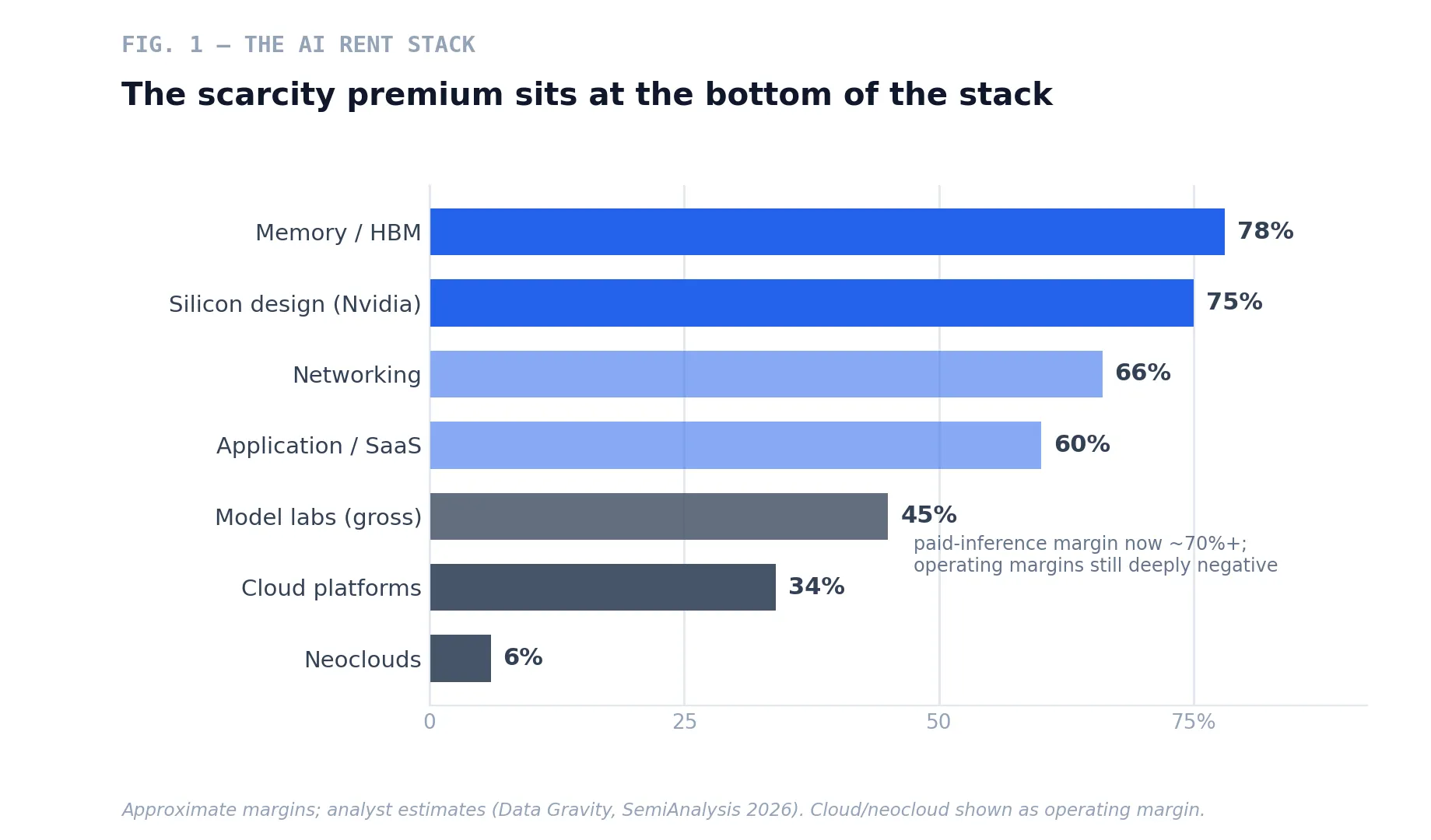
Two forces move down this stack together. The scarcity premium falls downward, so the layers closest to the metal capture the richest margins. And commoditization falls downward too, so the price of the model layer’s output keeps eroding. The result is that the model makers are squeezed from both sides—paying a premium for scarce compute below while the tokens they sell above get cheaper. Forward-deployed engineering is the ladder they are using to climb out of that squeeze toward the enterprise, where margin and stickiness still live. For the cloud landlords, the same engineers are something cheaper: inexpensive insurance, funded from operating cash flow, that the compute they have already committed to gets consumed.
An Opportunity and a Liability
For an enterprise leader, all of this resolves into a single, practical fact: a forward-deployed engagement is a double-edged instrument. It can leave you more capable—genuine help across the last mile that most organizations cannot staff—or it can leave you dependent on a subsidy that can be withdrawn and a vendor whose balance sheet you have quietly taken onto your own. Both outcomes wear the same job title.
The distinction that matters A deployment engagement is healthy when the vendor is working itself out of a job, and dangerous when it is working itself into a permanent one. The first leaves you self-sufficient. The second leaves you renting a capability you were told you were building.
The tell is trajectory. In a durable engagement, revenue per embedded engineer rises while the number of engineers a given customer needs falls—five become one—because the product is maturing underneath the relationship. In the other kind, the ratio never improves, because the gap between what the product ships and what you need is not closing. That is a measurable thing, and it is the thing to measure before you sign. So is counterparty risk: concentrating your AI strategy on a single vendor means taking on that vendor’s compute commitments and its place in an increasingly circular web of financing, in which chipmakers invest in model labs that spend the money back on compute, and the same dollar is counted as demand in several places at once.8
None of this argues against adopting AI, and none of it argues against embedded engineers. The individual gains are real and the deployment help is often genuinely useful. It argues for underwriting the offer as the financial instrument it is—pricing the withdrawal, not just the arrival; keeping your model choices substitutable; and justifying the spend on efficiency you can see in your own telemetry rather than on a macro story that may be partly self-undermining. The vendors have already told you, in their capital allocation rather than their keynotes, that the model is no longer the moat. What they are selling in its place can be a partnership or a dependency you never priced, and telling the two apart is now a core procurement competence.
I have laid out the full analysis—the rent stack layer by layer, the viability of each cloud landlord, the circular financing that couples them, and a complete framework for underwriting a deployment offer—in a longer white paper.
Read the full analysis: The AI Rent Stack →
References
- “Anthropic, Blackstone, and Hellman & Friedman Introduce Ode with Anthropic,” Business Wire, July 15, 2026; Julie Bort, “Anthropic, Blackstone Bet the Next Trillion-Dollar AI Business Is Implementation, Not Models,” TechCrunch, July 15, 2026. The $1.5 billion figure is as reported; the founding release does not disclose it.
- “OpenAI Launches The Deployment Company,” OpenAI, May 11, 2026; “Introducing Microsoft Frontier,” Microsoft, July 2, 2026; “Google Cloud Commits $750 Million to Partners’ Agentic AI Development,” Google Cloud, April 22, 2026; “AWS Generative AI Innovation Center,” Amazon, 2023–2025.
- “Palantir Reports Q1 2026 Results,” Palantir Technologies / U.S. SEC, May 4, 2026.
- “LLM Inference Price Trends,” Epoch AI, 2026 (median decline per fixed task; reasoning models excluded because they consume far more tokens).
- “OpenAI’s Financials, Leaked,” Fortune, June 16, 2026 (2025 revenue ~$13.07 billion; operating loss ~$20.92 billion).
- “Big Tech’s AI Spending Plans,” compiled from Q1 2026 earnings guidance (Financial Times; company IR). 2025 actual; 2026 projected.
- Aditya Challapally et al., “The GenAI Divide: State of AI in Business 2025,” MIT NANDA, August 18, 2025 (measures visibility of P&L impact).
- “Circular Financing Has Muddied the AI Story,” IDC, 2026; “Nvidia–OpenAI Deal Not Signed Yet,” Fortune, December 2, 2026 (the widely reported $100 billion commitment was a letter of intent, later restructured into a ~$30 billion equity stake).