One Codebase, Seven Models
Walk through an engineering floor of a mid-sized enterprise software company in July 2026 and you will find something that did not exist two years ago: developers running different foundation models against the same codebase, in the same sprint, writing code that ends up in the same production system.
One developer is on Claude Sonnet 4.6 through Cursor because a teammate recommended it for TypeScript refactoring. A second is using GPT-5 through the Copilot model picker because the team has an enterprise Copilot contract. A third is using Windsurf—now rebranded as Devin Desktop after Cognition’s acquisition—because she prefers its multi-file context handling for the Python microservices her squad owns.1 A fourth has a personal API key to a frontier model running as a terminal agent, not on any company-sanctioned tool at all.
None of them are doing anything wrong. The tools are good. The models produce useful code. The productivity gains are measurable: developers complete tasks up to 55% faster, and AI-generated code now accounts for more than 46% of lines written by Copilot users on average.2 The problem is not whether these tools work. The problem is what happens when no one owns the question of which tools are running, on what data, under what cost model, and subject to what contractual protections—across a fleet of hundreds of developers.
That is the multi-model governance problem. And most enterprises have not built a framework to address it.
The Governance Gap Multi-model flexibility emerged faster than enterprise governance frameworks could adapt. Most organizations that deployed AI coding tools between 2024 and 2026 did so before any formal governance policy existed. The average time from pilot to production for AI developer tooling was less than 90 days—faster than a typical vendor security review cycle.
What “Multi-Model” Actually Means at Enterprise Scale
The term is used loosely and it is worth being precise.
At the individual tool level, multi-model means a developer can select which foundation model their coding assistant uses for a given interaction. GitHub Copilot’s model picker offers GPT-5 variants, Claude models, and now Polaris as the default. Cursor’s Auto mode dynamically selects among the models it has access to based on the task type. Windsurf/Devin similarly supports frontier model routing.3
At the organizational level, multi-model means different teams standardizing on different primary tools—some on Copilot, some on Claude Code, some on Cursor—each backed by different model providers, different contractual arrangements, different data handling policies, and different IP protections.
Both definitions are in play simultaneously at most enterprises, and both create governance challenges. The distinction matters because the solutions are different. Managing model selection within a single approved tool requires configuration policy. Managing heterogeneous tool adoption across an organization requires vendor governance, procurement coordination, and security posture alignment.
The AI coding tools market has structured itself in a way that makes both challenges harder. Cursor reached $2 billion in annualized revenue and over 2 million users as of early 2026, with adoption across half the Fortune 500, by being excellent before enterprise procurement could catch up to it.4 Claude Code hit $2.5 billion in roughly ten months, driven by engineering teams who found it superior for complex agentic tasks and adopted it before corporate IT had reviewed it.5 The tools spread through developer communities faster than compliance reviews could follow.
The Benefits Are Real (and the Rationale for Governance Is Not Anti-Tool)
Any governance framework that treats multi-model AI adoption as a problem to be stopped will fail. The productivity case is genuine, the developer preference signal is strong, and the competitive pressure to ship software faster is not going away.
Gartner projects that by end of 2026, 75% of developers will spend more time orchestrating AI agents than writing code directly.6 The World Economic Forum’s Future of Jobs Report 2025 estimates that 39% of current technical skills will transform by 2030.7 This is the direction the industry is moving. Governance frameworks built on restriction rather than structure will erode through shadow adoption, which is more dangerous than sanctioned use because it produces no audit trail at all.
The legitimate case for multi-model flexibility in enterprise environments includes:
Different models genuinely perform better on different tasks. On low-resource languages—Rust, Haskell, OCaml—specialized models trained on those corpora outperform general-purpose models in ways that are measurable in daily developer experience. On complex agentic reasoning across large codebases, Claude Code’s terminal-native architecture offers capabilities that inline completion tools do not. On cost-sensitive high-volume completion workflows, a smaller, faster model may be the right default even if it is not the frontier leader on benchmarks.
Model concentration risk is also real from the opposite direction. An organization that standardizes every developer on a single model is exposed to that model’s failure modes, quality regressions, service outages, and pricing changes in a way that a diversified portfolio is not. The March 2026 outage that took Claude down for fourteen hours while leaving the API largely functional is an example of a service-level risk that affects single-tool organizations more severely than diversified ones.8
The argument for multi-model governance is not against model diversity. It is for structured diversity, where the range of tools and models in production is intentional, documented, and subject to consistent oversight—rather than a function of whatever each developer happened to try and prefer.
The Four Governance Problems That Actually Need Solving
1. Data Handling Inconsistency
Different tools process proprietary code differently, and the gaps are significant enough to matter to security and compliance teams.
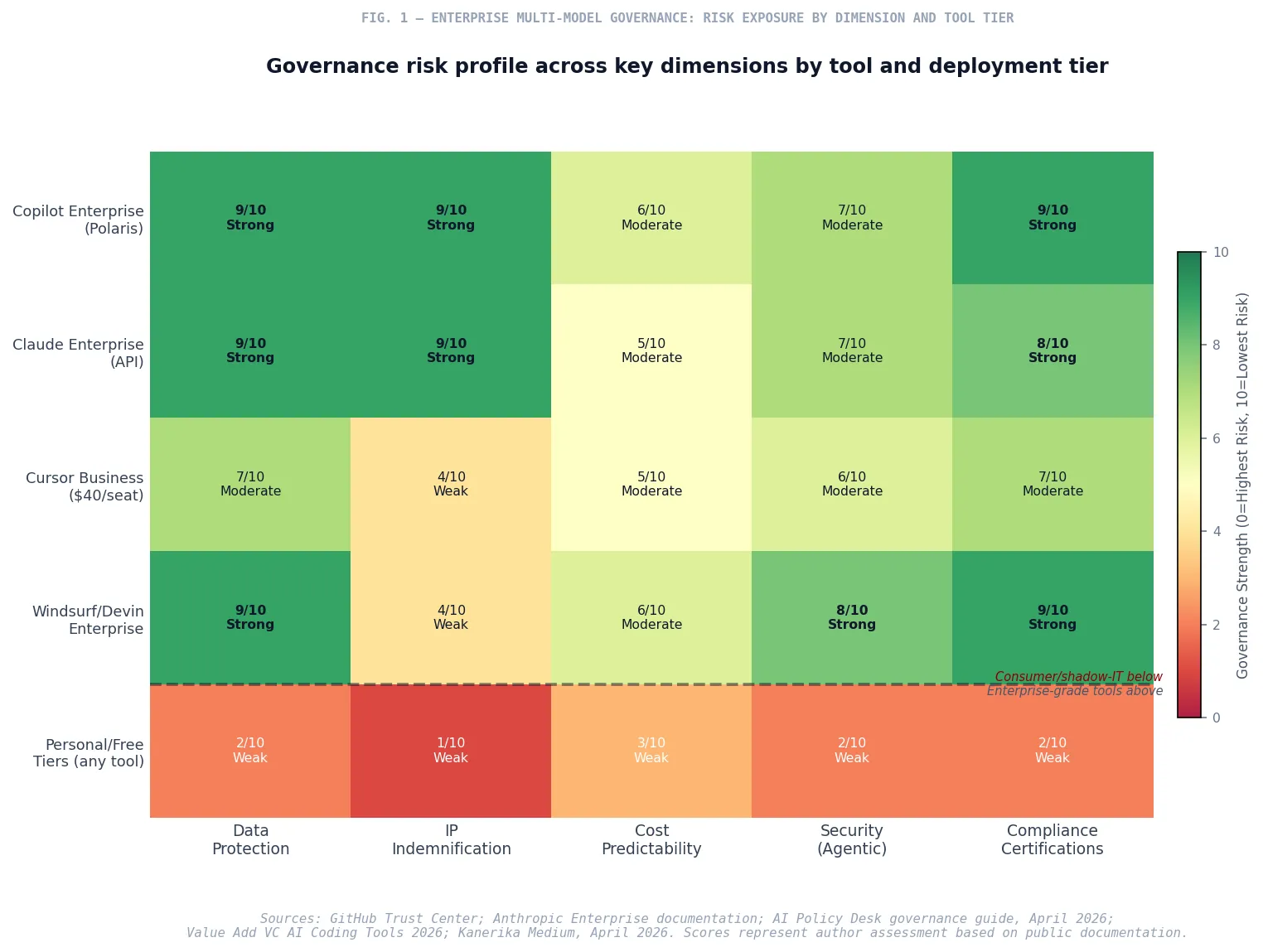
GitHub Copilot Business and Enterprise prohibit training on customer code. Anthropic’s Enterprise and API tiers offer the same protection with configurable retention. Cursor offers Privacy Mode that prevents code storage at Cursor’s servers, though code still transits to the underlying model API providers (OpenAI, Anthropic) for inference. The distinction matters: a developer in Privacy Mode on Cursor is not sending code to Cursor, but is sending it to whichever model provider Cursor routes to for that interaction.9
Windsurf Enterprise provides VPC and on-premises deployment options, enabling teams to keep code execution entirely within their infrastructure.10 For healthcare, defense, and financial services organizations with strict data residency or network egress requirements, this is not a preference—it is a compliance requirement that determines which tools can be used at all.
The governance gap is that most enterprises have not mapped which tools are in use across their developer fleet, which tier of those tools each developer is on, and what data handling policy each tier applies. Free and personal-tier subscriptions of most AI coding tools carry consumer-grade data terms that are explicitly not enterprise-grade. A developer using a personal Cursor free account from a company device, on a company codebase, is operating outside any enterprise data protection agreement.
2. IP Liability Coverage Gaps
The IP indemnification landscape for AI-generated code is not uniform across providers, and the gaps expose enterprises to unquantified risk.
GitHub Copilot Business and Enterprise include uncapped IP indemnification for unmodified Polaris-generated (and previously GPT-4 Turbo-generated) suggestions when content filtering is enabled. Anthropic extended copyright indemnification to Claude API and Enterprise customers in January 2024, covering defense and settlement costs for authorized use.11 Cursor and Windsurf/Devin do not offer comparable first-party IP indemnification—their enterprise value propositions are built on privacy, compliance certifications, and model quality, not IP coverage.12
In an organization where some developers are on Copilot Enterprise (covered) and others are on personal Cursor subscriptions or unapproved terminal agents (uncovered), the IP exposure is unpredictably distributed. When AI-generated code with a copyright question surfaces eighteen months after it was written, determining which model generated which lines—and which contractual coverage applied—is not straightforward.
3. Cost Transparency and Budget Control
The shift from seat-based pricing to consumption-based, token-metered billing has happened faster than enterprise budget models can absorb.
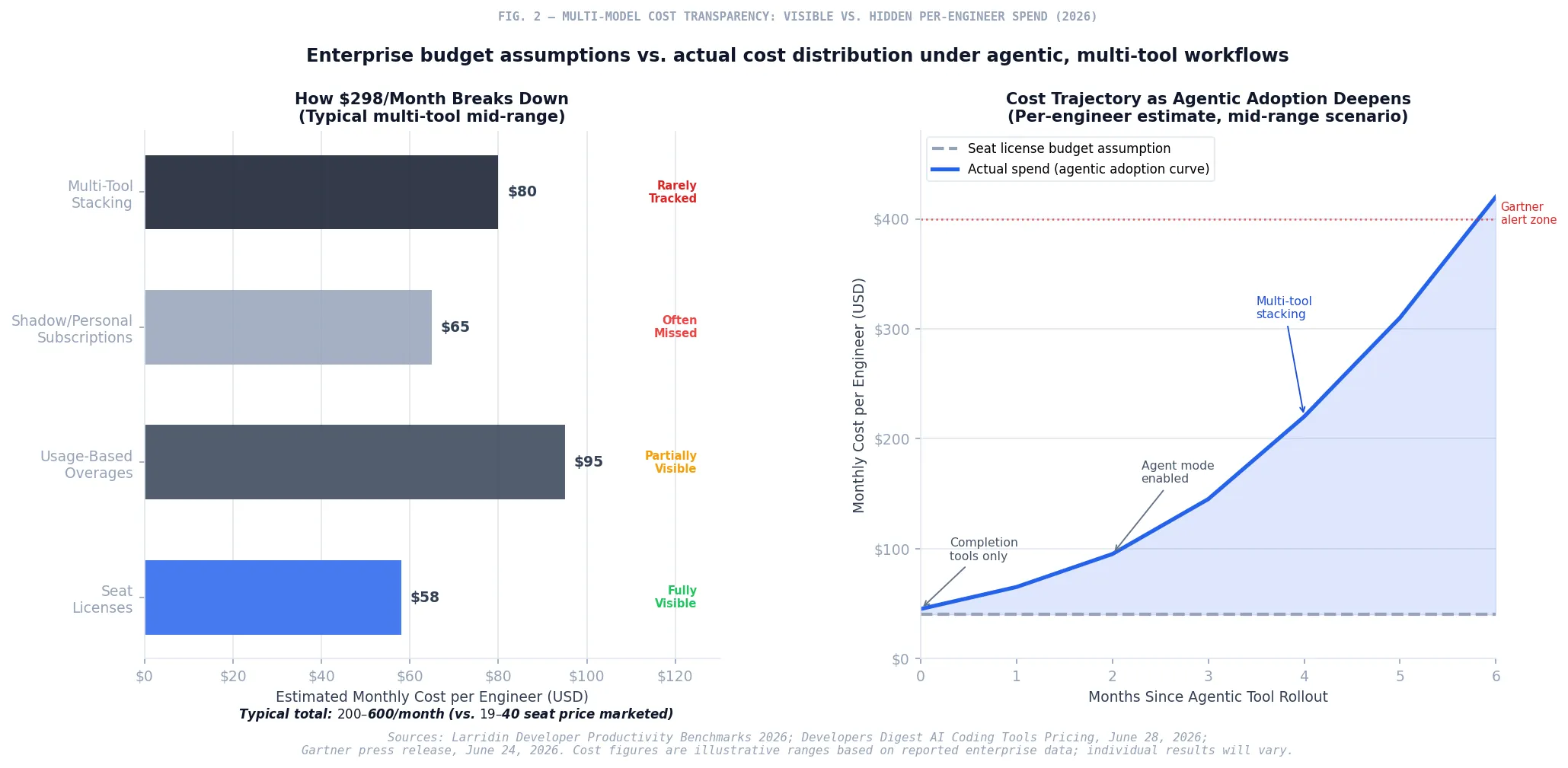
Gartner’s June 2026 forecast is direct: AI coding tool costs are projected to surpass the average developer salary by 2028 as agentic workflows consume tokens at rates that seat license pricing was not designed for.13 Enterprise data from May 2026 puts the actual all-in cost of AI developer tooling—including usage-based overages across multiple tools—at $200 to $600 per engineer per month, against headline seat prices of $10 to $40.14
The variance compounds in multi-model environments. Each tool has different pricing mechanics. Copilot moved to usage-based billing in April 2026, with premium model requests metered above the seat allowance. Claude Code on the API charges per token with usage rates that scale steeply under agentic workflows. Cursor Ultra reaches $200 per month. A developer who legitimately uses four tools in a day can run up cost exposure across four separate billing relationships, none of which has visibility into the others.
Gartner’s specific concern is that many vendors lack transparency into how token consumption is calculated and billed, limiting enterprises’ ability to accurately forecast and control costs.15 Without cross-tool telemetry, a CTO trying to understand total AI tooling spend across a 200-person engineering organization is working from incomplete information.
4. Security Policy Inconsistency in Agentic Contexts
Inline completion tools send code snippets to model providers. Agentic tools send entire repository contexts, API keys if not properly scoped, internal system architecture patterns, database schemas, and infrastructure configuration files. These are categorically different risk surfaces, and most enterprise security policies were written for the former.
Multi-agent workflows—now available in Copilot’s VS Code preview, Claude Code’s native architecture, and Cursor’s Background Agents—increase both the volume and sensitivity of what is routed to model providers.16 An orchestrator agent that spawns sub-agents for linting, testing, documentation, and security review is making multiple inference calls, each with its own context window, each carrying potentially sensitive code artifacts.
If your acceptable-use policy requires that developers not share proprietary code with non-approved vendors, and your developers are using unapproved personal-tier tools in agentic mode on proprietary repositories, you have a policy violation that is invisible to your security team.
What a Working Governance Framework Actually Requires
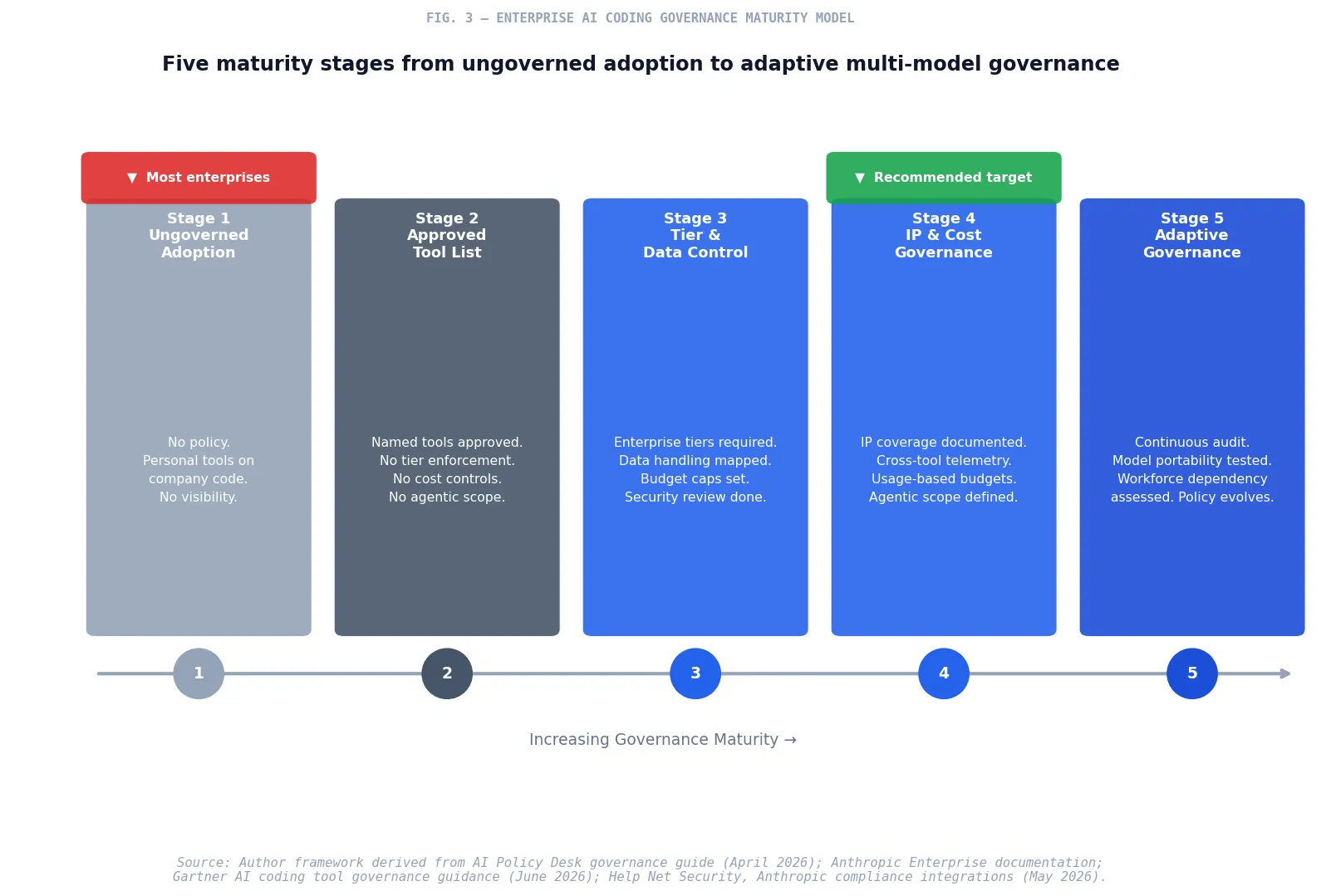
Most enterprises approaching this for the first time reach for an approved-tool list and call it governance. That is a starting point, not a framework. A list of approved tools tells developers which tools they can use. It does not tell the organization how those tools handle its code, what those tools cost across their full pricing structure, what IP exposure they carry, or what security posture they apply to agentic workflows.
A working enterprise multi-model governance framework requires five operational components:
Tool inventory and tier auditing. Before you can govern AI coding tools, you need to know what is running. This means inventorying not just which tools are approved, but which tier of each tool is deployed, since Business and Enterprise tiers differ materially from Free and Pro tiers on every relevant dimension. Shadow usage—personal subscriptions on company devices—is the most common governance gap and the hardest to discover after the fact.
Data classification mapping. Each repository and codebase should carry a classification that determines which tools and which data handling tiers are permissible. Public or low-sensitivity code may reasonably be processed by a wider range of tools and tiers. Repositories containing proprietary algorithms, customer data schemas, or regulated data must be matched to tools with contractually appropriate data protection.
IP coverage documentation. Legal teams should maintain a current map of which developers, using which tools at which tiers, are covered by vendor IP indemnification. This map should be updated when tool policies change—as they did when Microsoft migrated to Polaris—and when developers switch between tool tiers.
Consumption cost governance. Budget controls for AI tooling should operate at the tool and model level, not just the seat level. Organizations that have not enabled per-org budget caps in Copilot, per-workspace limits in their Claude Enterprise deployment, or equivalent controls in other tools should do so before agent-mode usage accelerates. Token consumption under agentic workflows can exhaust monthly budgets in days on uncontrolled configurations.
Security policy extension to agentic scope. Existing acceptable-use and data handling policies should be explicitly extended to cover agentic inference calls. The test is simple: whatever data the policy prohibits sharing with unapproved vendors should also be examined against what agentic tools are routing to their model providers. The answer may require MCP server allow-listing, network egress controls, or tool-level scope restrictions.
| Governance Dimension | Enterprise-Grade Controls Required | Typical Gap in Current Deployments |
|---|---|---|
| Data handling | Enterprise/Business tier with documented DPA | Personal-tier usage on company code; mixed tiers per team |
| IP indemnification | Documented coverage per tool and per tier | Coverage map not maintained; gaps as tools change pricing |
| Cost control | Per-tool budget caps; token consumption telemetry | Seat-price budgets only; no visibility into usage-based overages |
| Security (agentic) | Scope limits on agentic context; MCP allow-lists | Policies written for completion tools; agentic scope not addressed |
| Audit trail | Cross-tool telemetry; model-level logging | Per-tool logs in isolation; no unified view across tool fleet |
The Vendor Landscape: What Providers Are Building for Enterprise Governance
The market response to enterprise governance requirements has been uneven, but the direction is clear. Providers are building governance infrastructure because the absence of it is a procurement blocker.
Anthropic added 28 security and compliance integrations in May 2026, building a Compliance API that gives enterprise IT and security teams programmatic access to Claude activity data—conversation content, uploaded files, and activity events—for integration with existing SIEM, DLP, and observability tooling.17 The integrations cover Cloudflare, CrowdStrike, Datadog, Microsoft Purview, Okta, Palo Alto Networks, and twenty-three others. For enterprises already running these tools, governing Claude usage becomes a configuration problem rather than an architecture problem.
GitHub’s Copilot Enterprise includes centralized audit logs, organization-wide policy controls for model selection and content filtering, and admin controls over which MCP servers developers can access from their IDEs.18 The model picker—which allows routing to third-party models including Claude and Gemini—is controllable at the organization level, meaning IT administrators can restrict model access to approved options without developer awareness.
Windsurf/Devin’s enterprise tier offers VPC deployment and ITAR coverage, making it the only major commercial coding tool currently supporting federal and defense procurement constraints.19 Cursor’s enterprise offering added self-hosted cloud agent capability—code and tool execution on the organization’s own infrastructure—as a meaningful step toward the isolation requirements that regulated enterprises demand.20
What none of these tools provide natively is cross-tool governance: a single control plane that enforces consistent policy across multiple AI coding tools deployed in the same organization. That capability is emerging from third-party AI security posture management tools—several of which are now in the Anthropic compliance integration list—but it requires active deployment rather than automatic coverage.
The Organizational Risk Most Leaders Are Not Tracking
One consequence of rapid, ungoverned multi-model adoption deserves specific attention: the emergence of individual developer dependency on specific AI models, and the organizational risk that creates at the workforce level.
Gartner predicts that by end of 2026, 75% of developers will spend more time orchestrating AI agents than writing code directly.21 The World Economic Forum estimates 39% of current technical skills will transform by 2030.22 These shifts are real—and they carry a workforce risk that is separate from the data and cost questions. Developers who have oriented their workflows around a specific model’s behavior, context handling, and completion patterns are acquiring model-specific skill, not portable capability.
A developer who has spent six months building expertise in Claude Code’s agentic workflows has genuine, valuable expertise. But if that tool becomes unavailable—through pricing changes, service disruption, enterprise policy changes, or competitive shifts—the workflow dependency they have built does not transfer cleanly to a different model with different behavior. Model switching costs are real even when tool switching appears free.
Enterprise AI governance frameworks rarely address this. They focus on data, cost, and security—the measurable, auditable dimensions. The workforce dimension is harder to quantify and easier to defer. But the question of whether your engineering organization’s institutional knowledge is embedded in portable skills or proprietary model behavior is worth examining before the answer becomes apparent in a crisis.
A Practical Governance Starting Point for Organizations Behind the Curve
Most enterprises reading this will recognize that they are not where they should be on multi-model governance. The gap closed faster than anyone planned for. The starting point is not a comprehensive framework—it is three concrete actions with a short time horizon.
Conduct a tool and tier inventory this quarter. Ask every developer team which AI tools they are using, at which tier, and on which repositories. The results will likely reveal both shadow usage and tier inconsistencies that create data protection gaps. This inventory is the prerequisite for everything else.
Enable budget controls before expanding agentic access. If your organization is planning to roll out multi-agent workflows, Copilot Workspace, or agentic Claude Code access, establish per-team or per-developer token budgets before deployment—not after the first unexpected invoice. The Gartner trajectory on AI coding costs is not a forecast to plan around; it is an operational constraint to govern proactively.
Extend security policy review to agentic context scope. Convene a session between your security team and two or three power users of agentic AI tools. Have the developers demonstrate, in a controlled environment, exactly what context flows to model providers during a typical agentic session. Most security teams will discover scope they did not know existed. The session is less expensive than the breach review that follows an undiscovered exposure.
Multi-model flexibility is not a problem to be solved. It is a capability to be managed. The enterprises that build the governance infrastructure to manage it intentionally will compound the productivity gains the tools deliver. The ones that do not will discover the costs of ungoverned flexibility at an inconvenient time.
A Standard Worth Holding
The AI coding tools on the market in 2026 are, on balance, genuinely valuable. The productivity data is real, the capability improvements are accelerating, and the trend toward agentic workflows will not reverse. Enterprise governance frameworks that acknowledge this—that start from “how do we get the value safely” rather than “how do we prevent the risk”—are both more practical and more likely to succeed.
The multi-model reality is that developers will use the tools that make them most effective, and the tools that make them most effective will change over time as the frontier moves. Governance infrastructure built for this reality—inventory systems, tier-aware data policy, consumption telemetry, and security posture that explicitly addresses agentic scope—is the work that makes model diversity an enterprise asset rather than a liability.
The question is not which model is best. The question is whether you know what is running, what it is doing with your code, and what it will cost you at the end of the month.
References
- TECHSY, “Windsurf vs Cursor 2026: 6 Months In, The Verdict,” techsy.io, March 2026.
- GitHub Copilot Statistics, companieshistory.com, January 2026; Copilot Statistics 2026, sqmagazine.co.uk, June 2026.
- Daily.dev, “Cursor vs VS Code vs Windsurf: 2026 Comparison,” daily.dev, May 25, 2026.
- NxCode, “Windsurf vs Cursor 2026: Which AI IDE Should You Choose?” nxcode.io, March 2026.
- AIxploria, “Project Polaris: Microsoft Drops GPT-4 From GitHub Copilot and Goes In-House,” aixploria.com, June 2, 2026.
- First Line Software, “AI Software Development: What Changes from 2026 to 2035,” firstlinesoftware.com, June 2026. Citing Gartner, October 2025.
- World Economic Forum, Future of Jobs Report 2025, 2025.
- Suprmind, “Anthropic Claude Pricing 2026,” suprmind.ai, May 2026 (service outage reference, March 2–3, 2026).
- AI Policy Desk, “GitHub Copilot and AI Code Assistants: Governance Guide for High-Stakes Decisions,” aipolicydesk.com, April 27, 2026.
- Zapier, “Windsurf vs. Cursor: Which Is Best? [2026],” zapier.com, May 27, 2026.
- Anthropic, “Expanded Legal Protections and Improvements to Our API,” anthropic.com, December 19, 2023.
- Value Add VC, “Best AI Coding Tools 2026 Ranked,” valueaddvc.com, June 2026.
- Gartner, “Gartner Predicts AI Coding Costs Will Surpass Average Developer’s Salary by 2028 as Token Consumption Surges,” press release, gartner.com, June 24, 2026.
- Larridin, “Developer Productivity Benchmarks 2026,” larridin.com, March 20, 2026.
- Gartner, op. cit.
- Vibe Coder Blog, “GitHub Copilot Ships Project Polaris and Multi-Agent VS Code,” blog.vibecoder.me, June 2, 2026.
- Help Net Security, “Anthropic Adds 28 Security and Compliance Integrations for Claude,” helpnetsecurity.com, May 25, 2026.
- GitHub, “GitHub Copilot Features,” github.com/features/copilot, accessed July 2026.
- Tech Insider, “Windsurf vs Cursor 2026: 7 Tests, 1 Clear Winner,” tech-insider.org, April 2026.
- TECHSY, op. cit.
- First Line Software, op. cit.
- World Economic Forum, op. cit.