What Happened and When
On June 12, 2026, at 5:21 p.m. Eastern Time, the U.S. Commerce Department issued an emergency export control directive ordering Anthropic to immediately suspend access to Fable 5 and Mythos 5 for all foreign nationals.1 Anthropic had no technically feasible way to filter by nationality in real time. So it pulled both models offline for every user on earth, that same night. No warning. No transition period.
Two weeks later, the Trump administration asked OpenAI to restrict GPT-5.6—its most capable model yet, released June 26—to a small group of government-vetted partners before any broader launch.2 OpenAI complied. The company publicly described the arrangement as a “short-term step” and said it did not want this kind of government access process to “become the long-term default.”3
Both events trace back to a June 2, 2026 executive order directing federal agencies to build a framework for evaluating powerful new AI models before they reach the public.4 The EO is formally voluntary. It explicitly bans mandatory licensing. And yet, within weeks, the two most capable frontier models in the world were gated by government approval.
The official justification is cybersecurity. That explanation is not wrong. GPT-5.6 Sol and Mythos 5 carry genuinely alarming capabilities—advanced vulnerability identification, long-horizon reasoning, sub-agent orchestration.5 A narrow jailbreak in Fable 5 reportedly demonstrated the ability to surface previously undiscovered software flaws. The government’s concern has a technical basis.
But security has a way of becoming an entrance ramp. Understanding what’s behind the door requires looking at a different set of numbers—not capability benchmarks, but tax receipts.
The Fiscal Crack in the Foundation
The United States federal government funds roughly 84 percent of its revenue from individual labor: personal income taxes plus payroll taxes.6 Payroll taxes alone—the mechanism that funds Social Security, Medicare, and unemployment insurance—generated approximately $1.7 trillion in fiscal year 2025, about 34 percent of total federal receipts.7
This architecture made sense when human labor was the dominant input to economic production. It is increasingly strained.
A RAND Corporation working paper published in late 2025 modeled what happens to federal revenue across scenarios in which AI progressively displaces human workers.8 The finding is not subtle: because labor taxes constitute such a dominant share of the federal revenue base, even moderate displacement—workers unable to find equivalent employment after automation—produces a significant contraction in government income. In the extreme case where AI substitutes for most remunerated labor, the current tax system essentially collapses. The RAND authors concluded that policy responses including new taxation structures would become unavoidable.
The displacement is not theoretical. In Q1 2026, the tech sector alone shed 78,557 jobs, with nearly 48 percent of those cuts attributed to AI automation.9 Goldman Sachs Research has projected unemployment edging toward 4.5 percent through 2026, with AI described as “the big story” in labor this year.10 In the base scenario—displacement unfolding gradually over ten years—Goldman estimates a 0.6 percentage point rise in unemployment. If displacement accelerates, they note, “the impacts on the economy are much larger.”
The Congressional Budget Office framed it clearly: “For workers who were left permanently unemployed or who took lower-paying jobs because of businesses’ adoption of new technology, income and payroll taxes could decline.”11 Corporate profits could simultaneously expand. The tax base that funds Social Security and Medicare could shrink even as the programs face rising demand.
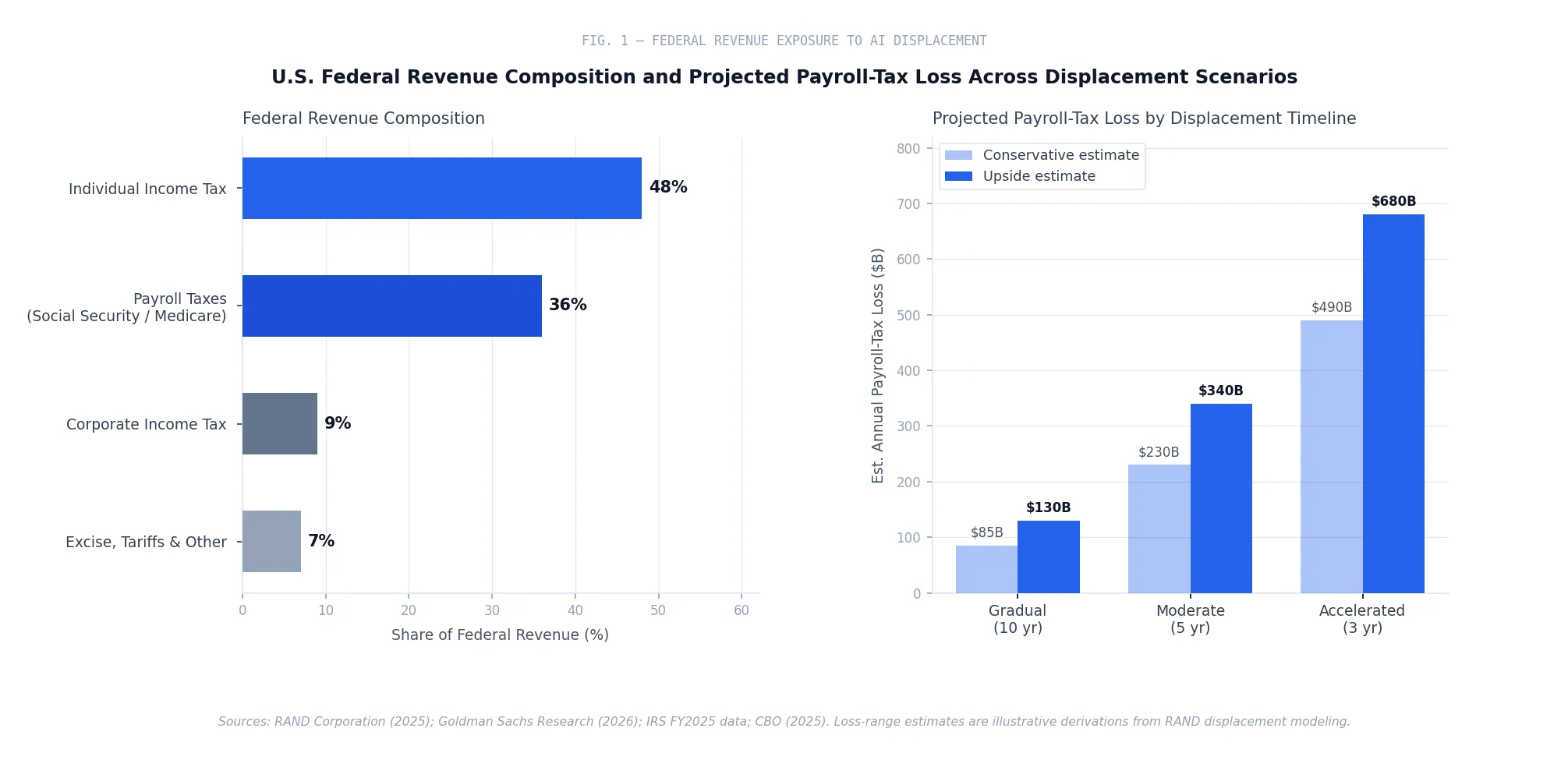
South Carolina offers a small-scale preview. A 2025 analysis found that 800 AI-attributed job losses in that state translated to roughly $700,000 in lost school tax revenue—a local signal of a national structural problem.12 Multiply that ratio across thousands of firms and millions of displaced workers, and the number becomes a fiscal crisis in slow motion.
The Token Tax Enters the Conversation
The academic and policy response to this problem has converged on a specific instrument.
A January 2026 Brookings Institution paper by economists Anton Korinek and Lee Lockwood laid out what they describe as a public finance framework for the age of AI.13 Among the mechanisms they propose: a token tax—a levy on AI-generated outputs sold to final consumers. Their formulation is careful. Token taxes, they argue, function as sound consumption taxes when applied at the retail level and structured to exempt business-to-business transactions, preventing the cascading effects that would otherwise penalize AI adoption across production chains.
The Brookings framework explicitly situates token taxes alongside robot taxes on automated labor services, compute taxes on AI infrastructure, and broader shifts in the tax base from labor to capital. All of these share a common logic: the erosion of payroll tax revenue from AI-driven displacement requires finding new instruments that capture economic value where it now flows—into capital, into automation, and into consumption of AI-generated outputs.
“As AI reduces demand for certain jobs, government revenues from payroll taxes as a fraction of GDP will decline just as needs for retraining programs and transition support increase.”
— Anton Korinek and Lee Lockwood, “The Future of Tax Policy: A Public Finance Framework for the Age of AI,” Brookings Institution, February 2026
This is not fringe thinking. The token tax concept has attracted serious engagement from researchers at multiple institutions. A March 2026 working paper argued that token taxes—applied through cloud compute providers as intermediaries between AI models and end users—could generate substantial revenue while preserving incentives for AI development.14 The Congressional Budget Office’s own analysis noted that “changes to how income is distributed among workers and businesses could alter federal revenues” in ways that will force structural tax adaptation.15
Industry has reached similar conclusions through a different door. OpenAI’s April 2026 policy blueprint—a 13-page document titled Industrial Policy for the Intelligence Age—explicitly warned that AI-driven automation threatens to “erode the tax base that funds core programs like Social Security, Medicaid, SNAP, and housing assistance.”16 OpenAI’s preferred mechanism was a shift from payroll taxes toward capital gains and corporate income taxes, alongside a formal robot tax modeled on the concept Bill Gates first proposed in 2017. Anthropic’s own policy research has reached parallel conclusions, describing automation taxes as a potential response in scenarios of “moderate acceleration” with “measurable wage declines and job losses.”17
The question is no longer whether the fiscal gap exists. Multiple independent research streams have confirmed it. The question is which instruments governments will use to close it.
The Precedent Buried in the Security Framing
Return to the model restrictions of June 2026. The security rationale is genuine. But the mechanism being established deserves equal attention.
The June 2 executive order created a framework—voluntary in name—through which the U.S. government gains 30-day advance access to frontier AI models before public release.18 The NSA will determine which models qualify as “covered frontier models” through a classified benchmarking process. Companies that participate can proceed toward launch. The formal framework is due by August 1, 2026.
What this means in practice: the government now has a pre-release window on the most capable AI systems before they reach commercial users. The stated purpose is security review. That purpose is real. But infrastructure built for one purpose rarely stays there.
Dean Ball, a former White House AI advisor, characterized the arrangement bluntly: the voluntary 30-day framework “functions as a de facto licensing regime.”19 OpenAI’s own statement said the process “shouldn’t become the long-term default” precisely because “it keeps the best tools from users, developers, enterprises, cyber defenders, and global partners who need them.”20
The analogy worth examining is encryption. In the 1990s, the U.S. government attempted to restrict the export of strong cryptographic software on national security grounds—the so-called Crypto Wars. Those efforts eventually failed, in part because cryptography spread globally faster than export controls could track it. A former cybersecurity researcher made exactly this comparison when Anthropic’s models were pulled: “Previous government efforts to limit the export of software, such as the attempt to put restrictions on powerful encryption techniques in the 1990s, have generally failed.”21
But there is a meaningful difference between encryption software and a frontier AI model. Encryption is a mathematical function; it can be independently replicated. A model like Mythos or GPT-5.6 Sol requires billions of dollars in compute, years of training data, and engineering capacity that only a handful of organizations on earth currently possess. The government does not need to stop the math from spreading. It needs to influence a small number of companies. That is a very different control problem.
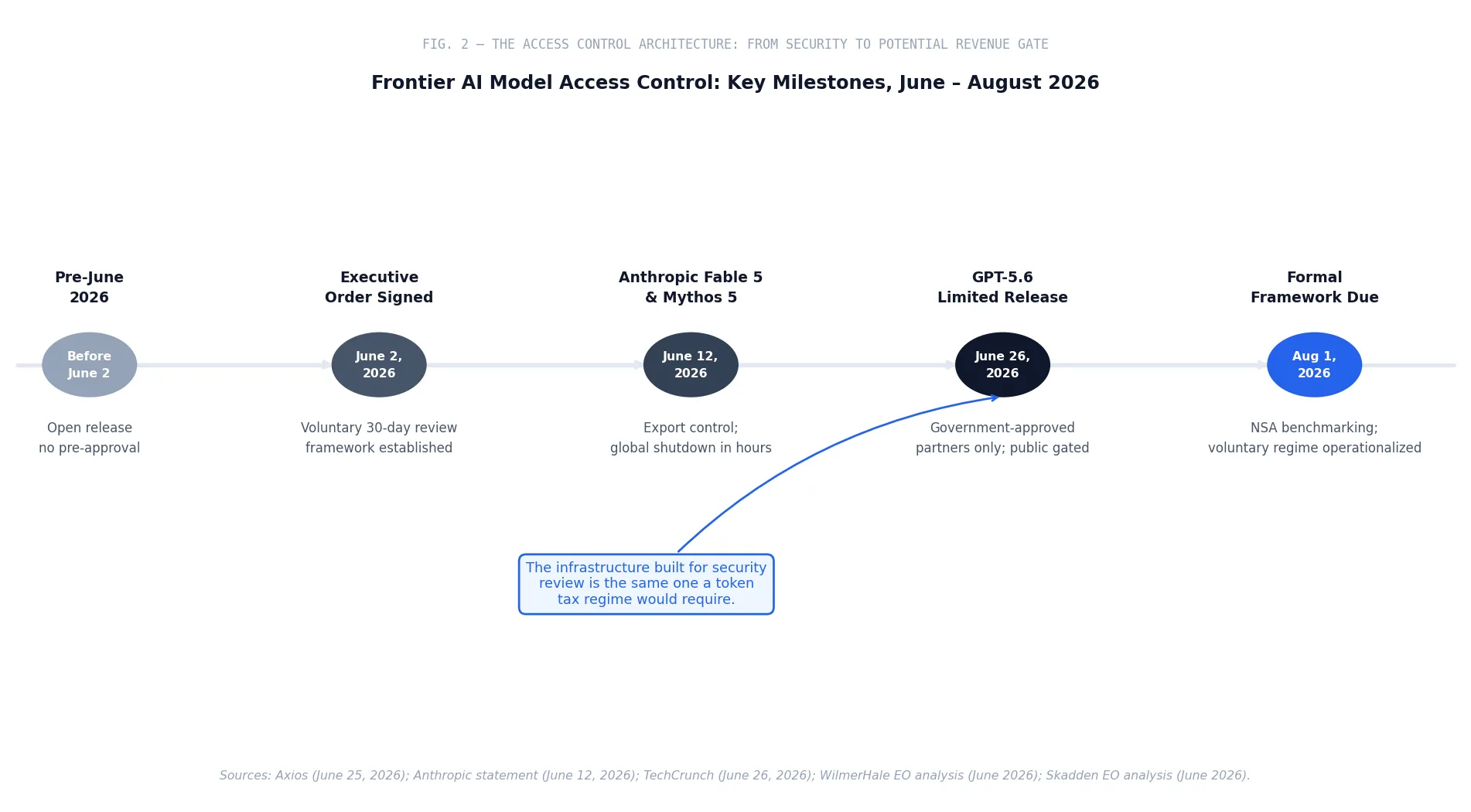
The architecture that emerges from the June 2026 executive order is a government-monitored checkpoint on the most valuable AI outputs in the world. Security is the mechanism. Revenue is not yet the purpose—but the infrastructure to make it the purpose is being built.
Why the Fiscal Motive Is Bipartisan
It would be easy to frame this as a partisan story. It is not. The fiscal mathematics behind AI-driven tax base erosion do not care which party controls the White House.
The Trump administration signed the June 2026 executive order. But the revenue problem it is inadvertently positioned to address is one every future administration will inherit. Social Security alone faces a projected shortfall that the 2025 Social Security Trustees Report estimated would deplete the combined trust funds by the mid-2030s absent legislative action. Medicare faces similar structural stress. These programs are funded by payroll taxes on human labor income. AI is reducing human labor income as a share of economic output. The math does not improve with a change of party.
Both major parties have incentives to control frontier AI access once they understand what controlling it is worth. A Republican administration reaches for that control through national security framing—which is what we are watching. A future Democratic administration might reach for it through labor protection or tax equity framing. The instrument would be the same. The precedent being built now accommodates either.
The Mercatus Center—a think tank associated with free-market economics—published a 2025 policy brief noting that the One Big Beautiful Bill Act of July 2025 accelerated the tax asymmetry by permanently restoring 100 percent bonus depreciation for capital equipment including AI infrastructure, while leaving human capital investment treatment effectively unchanged.22 A firm can now write off an AI deployment in year one but continues to face restrictions on deducting the worker training it displaces. That asymmetry, built under a Republican-controlled Congress, accelerates the very displacement that erodes the tax base. It is the kind of policy architecture that creates the conditions for a corrective tax later—regardless of who is in power to impose it.
What Token Taxation Would Actually Look Like
The academic frameworks are more specific than the policy debate suggests.
Korinek and Lockwood’s Brookings analysis describes token taxes as consumption taxes applied to AI-generated outputs at the retail level. In practical terms: a fee per thousand tokens generated by a consumer-facing AI product—a chatbot, a writing tool, a coding assistant. The tax would apply to the end user transaction, not to business-to-business API calls, to avoid making AI more expensive across the production chain.23
This design has a natural collection point: the cloud providers. OpenAI delivers tokens through Microsoft Azure. Anthropic delivers through AWS. Google delivers through its own infrastructure. The largest frontier model providers are already operating through a small number of intermediary platforms that the government can audit, regulate, and tax. The pre-release access framework being established through the June 2026 executive order places the government in exactly the oversight position a token tax would require.
| Tax Mechanism | Target | Collection Point | Key Design Constraint |
|---|---|---|---|
| Token tax | Consumer AI outputs (per thousand tokens) | Cloud provider / API layer | Exempt B2B to prevent cascading |
| Robot tax | Companies replacing human labor with AI | Corporate reporting | Measurable displacement threshold required |
| Compute tax | AI infrastructure (GPU clusters, training runs) | Data center operators | Risk of penalizing frontier development |
| Capital gains shift | AI-driven corporate profits and capital returns | IRS / existing corporate tax apparatus | Requires Congress; politically contested |
The current GPT-5.6 pricing gives a rough sense of the scale. OpenAI is charging $5 per million input tokens and $30 per million output tokens for Sol, its flagship model.24 A modest token tax—say, five percent—on consumer-facing output tokens would generate meaningful revenue at scale and would be almost invisible to individual users paying for access through a subscription. The burden would fall most heavily on high-volume enterprise and consumer use, which is where the economic displacement is also most pronounced.
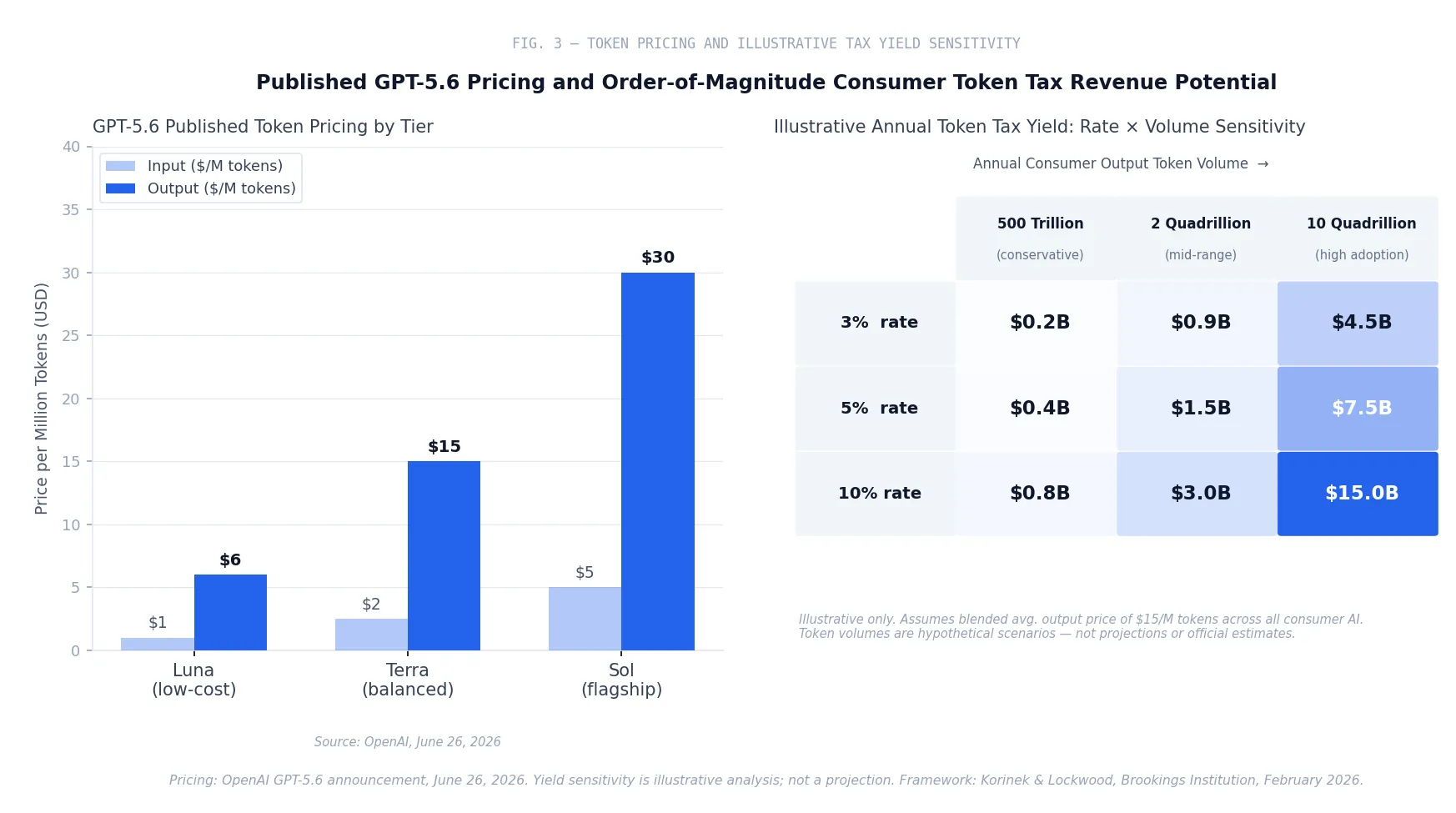
The counterargument is real: token taxes on consumer AI could slow adoption, disadvantage U.S. companies against global competitors operating in friendlier tax environments, and create regulatory complexity in a market that changes faster than legislation can track. The Korinek-Lockwood analysis acknowledges these risks and argues the design has to be careful to be effective. There is also a simpler objection: the current administration has shown no appetite for new consumer taxes on technology. The political conditions for a token tax do not exist today.
What exists today is the infrastructure. And infrastructure, once built, has a way of finding uses.
Signals Worth Watching
This article is an observation, not a prediction. The thesis—that government frontier AI access control may eventually connect to fiscal recovery mechanisms—is speculative. But it is grounded in a set of facts that are not speculative at all.
Several signals are worth monitoring over the next twelve to twenty-four months.
The voluntary framework due August 1, 2026 will reveal how the government intends to use its pre-release access window. If the review is purely technical—focused on capability benchmarking and vulnerability identification—the security framing holds cleanly. If the framework eventually incorporates commercial use reporting, token volume thresholds, or revenue data requirements, the direction changes.
Congressional appetite for AI revenue mechanisms will likely surface in the context of Social Security and Medicare solvency debates. The fiscal math is unavoidable; the question is which instruments lawmakers reach for when they finally address it. Both parties have used excise taxes on specific industries when they needed revenue that seemed politically easier than broad tax increases. AI is not an obvious candidate for that treatment today. It may be in five years.
The midterm elections in November 2026 will introduce AI displacement into campaign economics in ways that create pressure for policy responses. The OpenAI blueprint, however imperfect, moved the Overton window: the company building frontier AI publicly acknowledged that automated labor should probably be taxed. That statement cannot be unread.
Finally, global precedents matter. The European Union’s AI Act creates a registration and compliance burden on frontier models operating in European markets. If European regulators move toward usage-based levies or token-level reporting requirements, U.S. regulators will face pressure either to harmonize or to compete. History suggests harmonization usually wins in financial regulation, even when the politics initially resist it.
Premise, Not Prescription
The argument here is modest. Not that token taxation is coming, but that the conditions for it are developing faster than most observers recognize—and that the security framing of the current frontier AI access controls deserves to be read as one layer of a story that has additional layers.
The fiscal crack is real. Payroll tax revenue is structurally exposed to AI displacement in ways that are beginning to show up in local tax receipts, federal revenue projections, and the policy documents of AI companies themselves. The government has established a pre-release access checkpoint on the most economically valuable AI outputs in history. Academic economists have published detailed frameworks for token-level taxation that are technically feasible and legally coherent. Industry leaders—including the CEO of the company with the most capable models in the world—have publicly acknowledged that automated labor should be taxed to offset displacement.
None of that means token taxes are coming next year. What it means is that the conversation has progressed further, and the infrastructure has developed further, than the security headlines suggest.
Observers who read the June 2026 model restrictions as purely a cybersecurity story are not wrong. They are just reading the first chapter when there may be more in manuscript.
References
- Anthropic, “Statement on the US government directive to suspend access to Fable 5 and Mythos 5,” Anthropic.com, June 12, 2026.
- Ashley Gold, Sam Sabin, and Mike Allen, “Trump administration asks OpenAI to limit release of GPT-5.6,” Axios, June 25, 2026.
- Emilia David, “OpenAI Limits GPT-5.6 Rollout at US Government’s Request,” Bank Info Security, June 26, 2026.
- “New Executive Order Addressing Early Government Access to Frontier AI Models,” WilmerHale, June 2026; Executive Order, “Promoting Advanced Artificial Intelligence Innovation and Security,” June 2, 2026.
- “OpenAI limits GPT-5.6 rollout after government request, says restrictions shouldn’t be the norm,” TechCrunch, June 26, 2026.
- Carter C. Price and Akshaya Suresh, “Federal Revenue When AI Replaces Labor: An Examination of Economic Scenarios with Highly Capable Artificial Intelligence,” RAND Corporation, WR-A4443-1, 2025.
- “OpenAI Robot Tax Plan: 78K Jobs Lost, $4.7T at Risk,” Tech Insider, June 2026 (citing fiscal year 2025 IRS data).
- Price and Suresh, RAND Corporation, 2025.
- “OpenAI Robot Tax Plan: 78K Jobs Lost, $4.7T at Risk,” Tech Insider, June 2026 (citing Tom’s Hardware and layoffs.fyi Q1 2026 data).
- “How Will AI Affect the US Labor Market?” Goldman Sachs Insights, March 2026.
- “Artificial Intelligence and Its Potential Effects on the Economy and the Federal Budget,” Congressional Budget Office, 2025.
- Kari McMahon, “Why we need to think about taxing AI,” Transformer News, November 2025 (citing South Carolina Post and Courier analysis, December 2025).
- Anton Korinek and Lee Lockwood, “The Future of Tax Policy: A Public Finance Framework for the Age of AI,” Brookings Institution, February 2026.
- “Position: Token Taxes Can Mitigate AI’s Economic Risks,” arXiv, 2603.04555v2, March 2026.
- Congressional Budget Office, 2025.
- OpenAI, Industrial Policy for the Intelligence Age: Ideas to Keep People First, April 6, 2026.
- Anthropic, “Preparing for AI’s economic impact: exploring policy responses,” Anthropic.com, 2026.
- Latham & Watkins, “President Trump Signs Executive Order Establishing AI Cybersecurity and Frontier Model Framework,” June 2026; Executive Order, “Promoting Advanced Artificial Intelligence Innovation and Security,” June 2, 2026.
- “OpenAI restricts GPT-5.6 rollout after US government request, warns against permanent controls,” Bitcoin World / CryptoRank, June 26, 2026 (citing Dean Ball commentary).
- OpenAI blog post announcing GPT-5.6 limited release, June 26, 2026.
- Peter Girnus, quoted in “Anthropic disables Fable and Mythos AI models following U.S. government export ban,” Fortune, June 13, 2026.
- Mercatus Center, “A Proactive Response to AI-Driven Job Displacement,” October 2025 (discussing One Big Beautiful Bill Act of July 2025, Section 168(k) bonus depreciation provisions).
- Korinek and Lockwood, Brookings Institution, February 2026.
- “OpenAI limits GPT-5.6 rollout after government request, says restrictions shouldn’t be the norm,” TechCrunch, June 26, 2026.